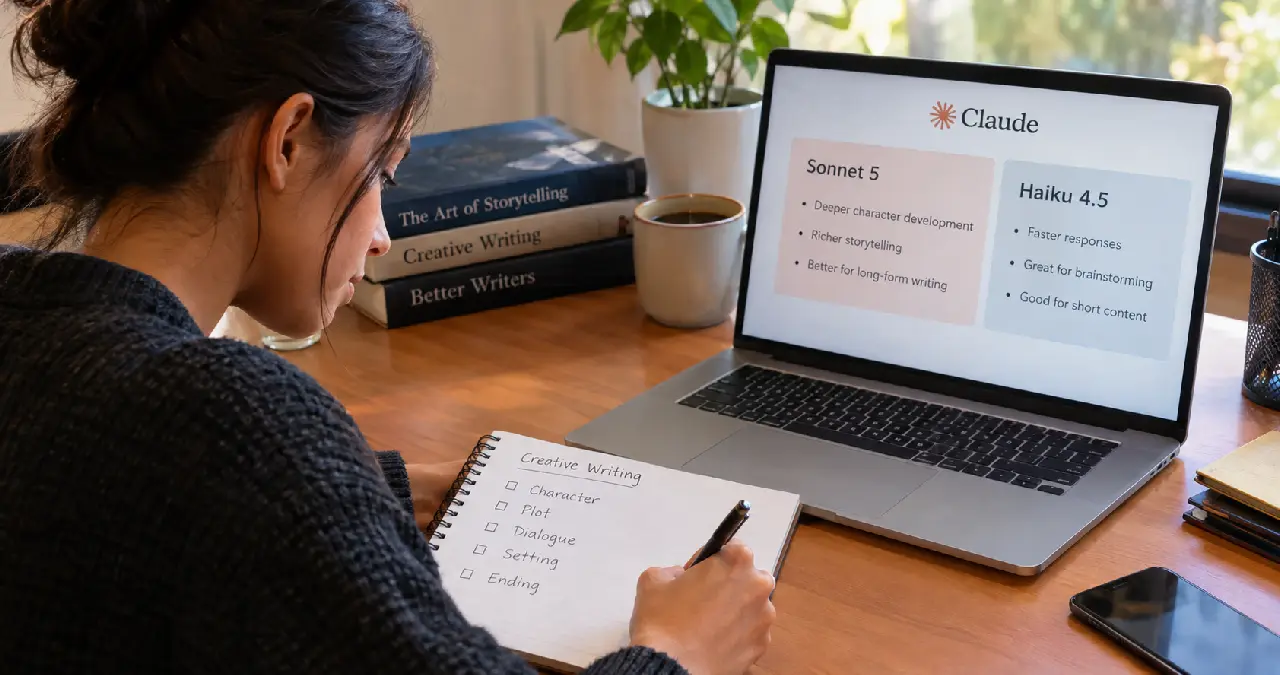
As a creative writer, expressing creative storytelling in a sleek manner sometimes leads to dependence on AI tools. Suppose you are starting on a blank Word document. The story is in your head, just waiting to reveal itself, but you find it intimidating as words don’t flow as anticipated. The best AI tool that assists with creative storytelling or writing engaging content is Claude. Claude AI is an advanced & sophisticated AI chatbot that was made by the AI research company Anthropic.
It offers a range of paid and free models. On Claude’s Free plan, users can access Sonnet and Haiku, although usage limits apply. While using the tool for my creative content writing, I found that these two models help me write without taking any paid subscription.
Here, on Webtechhelp, I share my honest introspection of exactly what I feel about the free Claude model and what gives me the best experience with my creative writing flair in terms of dialogue flow, story arc, and the voice of a narrative that others fail to deliver.
Creative writing definition
Unlike just the presentation of raw facts without any or little incorporation of emotion-driven flair, creative writing is a form of writing that effortlessly blends expressive language and imagination to share the ideas deep inside. It is an expression to convey unique ideas and thoughts engagingly.
All Claude models
| Model | Best suited for | Free plan? | Relative cost |
| Haiku 4.5 | Speed, brainstorming | Yes | Lowest |
| Sonnet 5 | General writing & creative drafting | Yes | Low |
| Opus 5 | Advanced reasoning & demanding work | No | High |
| Fable 5/5.1 | Long-running advanced workloads | No/limited by plan | Highest |
To know more, check the Compare models link.
Best free model
Claude has several model families, including Haiku, Sonnet, Opus and Fable. Each family contains specific model versions, and availability differs by plan. Among them, Haiku and Sonnet are free model need not go for a paid plan for creative writing assistance. Although the free plan for the models is available, both have also come up with paid plans based on usage limits.
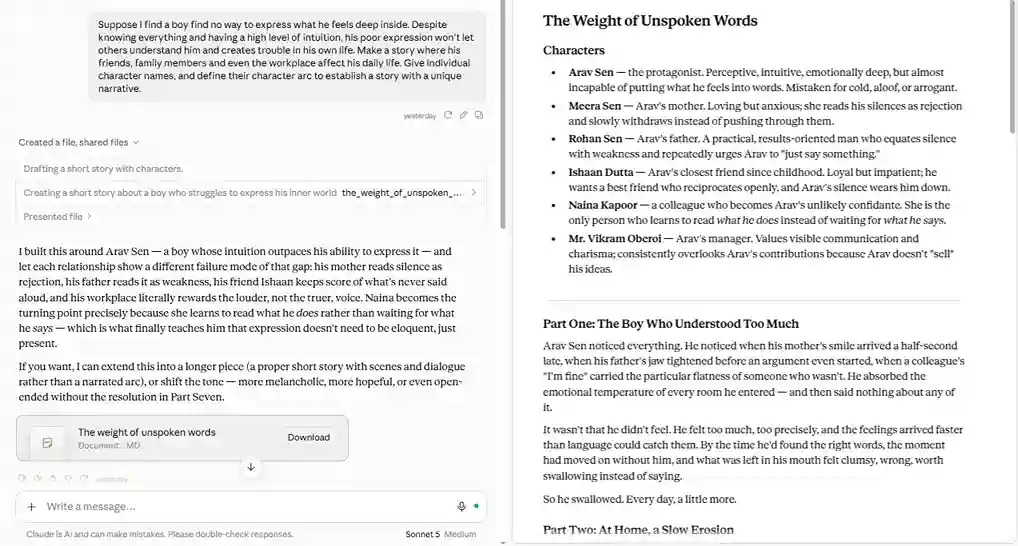
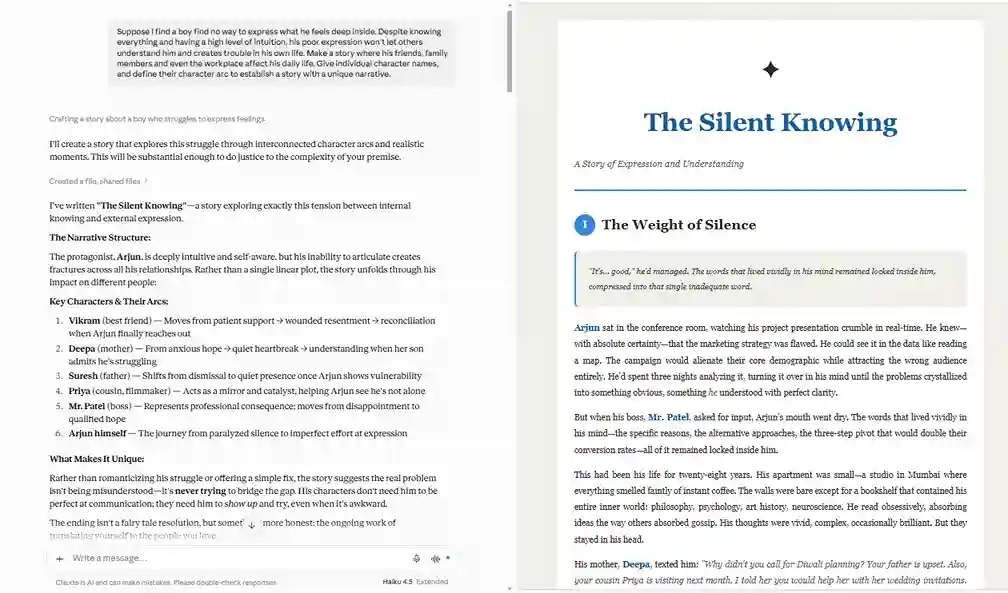
Suppose a story idea clicks in my mind, and I try to materialize the idea into a unique story. At first, I create a prompt to transform my idea into a polished manner with tone & voice customisation, realism, and dialogue quality. To hone what I’m actually looking for, I use the Free Tier Claude model to make a side-by-side comparison.
Prompt
| “Suppose I find a boy with no way to express what he feels deep inside. Despite knowing everything and having a high level of intuition, his poor expression won’t let others understand him and creates trouble in his own life. Make a story where his friends, family members and even the workplace are affecting his daily life. Give individual character names, and define their character arc to establish a story with a unique narrative.” |
Sonnet vs Haiku
Sonnet 5 produces grounded, literary & polished character detailing. Meanwhile, it is good for producing readable narratives with each character in the story for creative writing, with less content filled with generic filler. The dialogue of the story produced by Claude Sonnet 5 is naturalistic and filled with revealing dialogue. The story framed by Sonnet 5 is concrete, devoid of any vague descriptors. Sonnet 5 and Haiku 4.5 are ideal for users who demand quick iteration for their creative writing assistance.
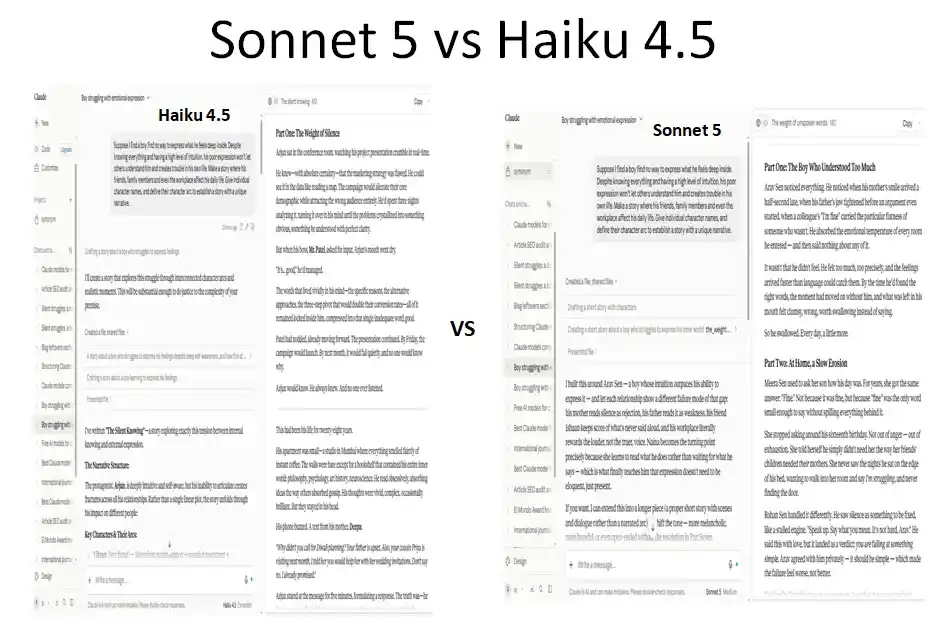
In my hands-on testing, Haiku 4.5’s story, ‘The Silent Knowing,’ hooked me immediately with no fluff. Sonnet 5 creates the story “The Weight of Unspoken Words” under the same comment prompt, where character development is much stronger and gradually developed through observation.
Character detailing in Haiku 4.5 provides a fairly direct characterisation. Sonnet 5, on the other hand, has character depth that appears with tiny details. In terms of clarity and giving the story a more emotionally layered frame, Sonnet 5 outranks Haiku 4.5. But according to me, Haiku 4.5 does one thing better: structural clarity and stronger plot premises.
Scoring Claude models based on my hands-on experience
| Category | Sonnet 5 | Haiku 4.5 |
| Character depth | 9/10 | 7/10 |
| Dialogue | 9/10 | 7.5/10 |
| Plot structure | 8.5/10 | 8/10 |
| Prose quality | 9/10 | 7.5/10 |
| Speed | 8/10 | 10/10 |
| Overall | 8.7/10 | 8.0/10 |
Why Sonnet 5 Over Haiku 4.5 – An Honest Introspection
In terms of daily writing requirements, the default model is Sonnet 5 over Haiku 4.5. If you are looking for faster brainstorming to process text with a fixed & faster outline, you may go for Haiku 4.5. Based on my hands-on testing, Sonnet 5 was my preferred free option for character depth and polished prose. Unlike lighter models like Haiku 4.5, Sonnet 5 differentiates the writing into narrative arcs with multifaceted subplots.
Haiku 4.5 tends to present the character directly; in contrast to that, Sonnet 5 does not infer the character as certainly as Haiku 4.5 does, but rather provides an ambivalent presentation, leaving room for readers to infer.
Haiku 4.5 is currently Anthropic’s lowest-priced listed Claude model for standard API usage. Despite this, Sonnet 5 is capable of fulfilling the writing requirement by producing concrete text, devoid of any vague descriptors for creative writing.
Comparison Table based on Results from our test
| Comparison | Claude Sonnet 5 | Claude Haiku 4.5 |
| Character nuance | Ambivalent, show-don’t-tell | Clear-cut, more expository |
| Prose style | Restrained, metaphor-driven | Readable, occasionally summary-heavy |
| Structure | Thematic, literary | Conventional arc and epilogue |
| Ending | Ambiguous, unresolved by design | Fully resolved, redemptive |
| Formatting polish | Clean | One template and artefact slip |
| Best for | Literary short fiction, nuanced character studies | Commercial-feel fiction, readers who want closure |
Free Limitations: Claude Sonnet 5 vs Haiku 4.5
| Feature | Sonnet 5 | Haiku 4.5 |
| Free Tier Access | ✅ Yes (Claude.ai) | ✅ Yes (Claude.ai) |
| Cost (Free) | $0 | $0 |
| Long Stories (1,500+ words) | ✅ Excellent | ⚠️ Adequate |
| Context Window | 1M tokens | 200K tokens |
| Speed | Moderate | Fastest |
| Rate Limit (Free) | Limited* | Limited* |
| Best For | Literary fiction, character depth | Brainstorming, fast ideation |
| Prose Quality | Excellent | Good |
| Recommended Default | ✅ Yes (creative writing) | ✅ Yes (speed/ideation) |
Which Claude model should you choose?
| If You Want | Choose | Why It’s Best |
| Fast Brainstorming & Quick Tasks | Haiku 4.5 | ✓ Fastest response ✓Lowest cost ✓ Quick iterations |
| Long-Form & Advanced Creative Work | Sonnet 5 | ✓ Excellent quality-to-speed✓Strong reasoning ✓ Professional standard |
| Highest-End & Most Advanced | Opus 5 / Fable | ✓ Maximum intelligence ✓Cutting-edge work ✓ Highest accuracy |
| Lowest API Cost | Haiku 4.5 | ✓ Significant savings✓High-volume scaling ✓ Routine tasks |
| Balanced Performance & Cost | Sonnet 5 | ✓ Sweet spot for production ✓Best per dollar ✓Most |
Read more: ChatGPT vs Grok.
Author opinion
It is worthwhile to mention that I don’t have any paid Claude subscription. That’s why I use the free Claude model (Claude Haiku 4.5 and Claude Sonnet 5) with a daily limit plan to enjoy my storytelling guide and assistance. According to me, both provide a good guide to brainstorm concepts and synthesise ideas.
But if you are opting for brainstorming, ideating, or drafting quick commercial fiction where speed is more significant than quality, then Haiku 4.5 is the on-the-go option. On the flip side of the coin, if you are deciding to write anything where prose quality, literary subtlety, or character depth matter, Claude Sonnet 5 will serve the purpose. Meanwhile, it is noteworthy that if you’re using Claude’s Free plan, Sonnet 5 is my recommended choice for creative writing, while Haiku 4.5 is better when speed and cost efficiency matter. If you’re willing to pay, higher-tier Claude models should also be considered. Check Anthropic’s pricing structure for a better understanding.
Frequently asked questions (FAQs)
Yes. Definitely, you can use Claude Sonnet 5 as the default Claude model, along with Haiku 4.5 that provides faster replies and quick brainstorming. Using the Claude model won’t demand credit card or a trial period.
If you are looking for quick outlines, fast iteration with quick brainstorming, Haiku 4.5 is a good-to-go option to assist you in your creative writing. Moreover, if you are looking for expository understanding with nuanced character work, Sonnet 5 would become the obvious stronger pick.
It is not necessary at all to go for Opus or Fable. They are Anthropic’s high-tier model serving the purpose of complex reasoning and agentic work at a larger scale. If you’re looking for assistance with your short fiction and creative writing tasks, Sonnet 5 already delivers strong results without any necessity to go for a paid plan.
Leveraging an identical prompt is a reliable way to judge which fits your specific writing voice, as the distinction of genre and prompt structure can create variance in the writing voice.