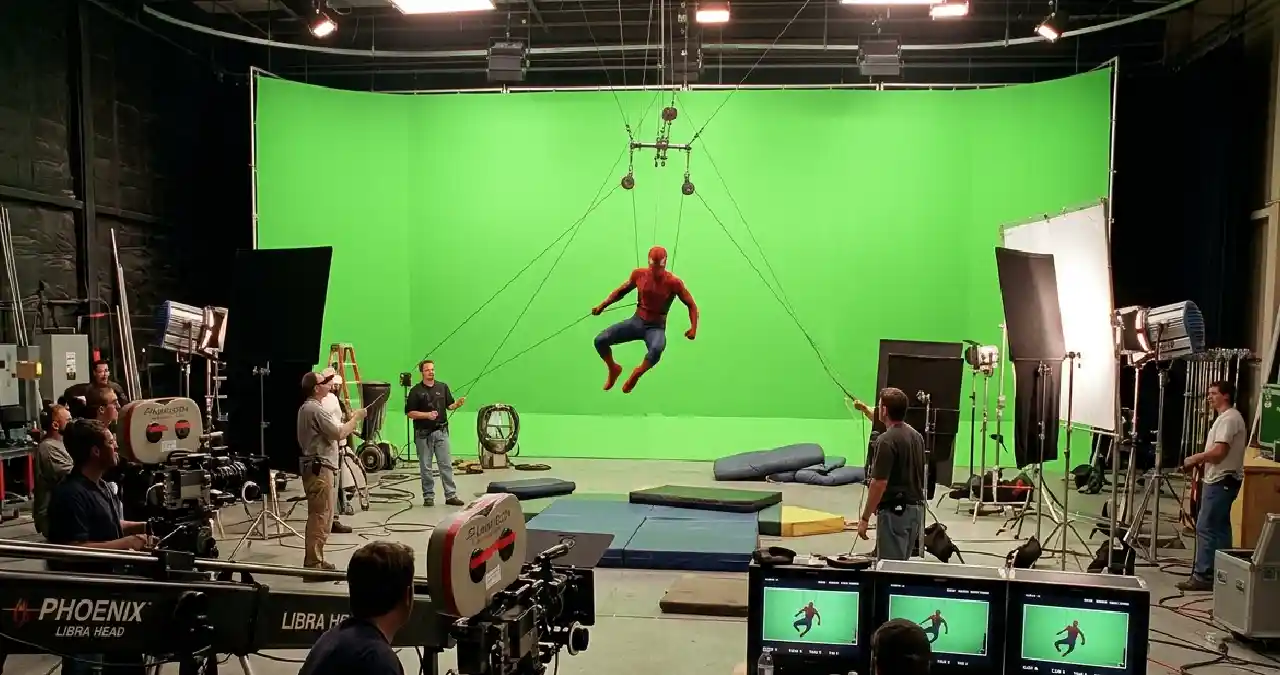
Spider-Man (2002) meticulously combined practical filmmaking with stunning visual effects. The production team utilize greenscreen/bluescreen photography, wire rigs, and Panavision 35mm film cameras for a beautiful depiction of digital Spider-Man characters.
Kudos to Sony Pictures Imageworks, which handled the major visual-effects work. Above all, John Dykstra and Scott Stokdyk served the roles of visual-effects designer and visual-effects supervisor on the movie. Let’s break down the technology to know the CGI pipeline, camera and effort of the visual-effects team to make Spider-Man (2002).
Filmmaking technology for Spider-Man (2002)
| Technology | Role in Spider-Man (2002) |
| Panavision Panaflex cameras | Principal photography |
| Primo lenses | Cinematography |
| CGI | Digital Spider-Man and impossible action |
| Keyframe animation | Digital character animation |
| Wire rigs | Practical stunt work |
| Maya | 3D/VFX production |
| RenderMan | Rendering |
| Sony Pictures Imageworks | Major VFX production |
What CGI technology was used in Spider-Man (2002)?
The movie director of 2002 Spider-Man, Sam Raimi, along with his visual team, perfectly blended the Computer-Generated Imagery (CGI) with practical stunts. The production team of the movie combined digital work with practical live-action stunts, showing the stuntman launched off from a rig and transitioned digital Spider-Man from mid-air to mid-swing. It is meanwhile impossible to physically present the Spider-Man characters.
The shot of the character Green Goblin, featuring Willem Dafoe, was made by brilliantly mixing digital CGI and stunt doubles. The spider bite, aerial acrobatics and web-slinging sequence of Spider-Man were brought to life with CGI.
How Sony Pictures Imageworks created digital Spider-Man
John Dykstra was the film’s visual effects designer who worked with the team at Sony Pictures Imageworks. For the first Spider-Man (2002), Scott Stokdyk was the visual effects supervisor whose team created the digital characters of the hero Spider-Man and the main antagonist of the 2002 Spider-Man, Green Goblin.
Anthony LaMolinara was the animation director of the movie Spider-Man, who played a crucial role in the core technical team. While Dykstra and Stokdyk oversaw every minute detail of the visual-effects pipeline, LaMolinara was in charge of looking for digitally crafted character and action sequences supervision in the entire movie to make sure how Spider-Man moves, swings, and lands in the movie, followed by other details. Dykstra, Stokdyk and LaMolinara were among the credited nominees who received the Oscar nomination of visual effect for the VFX.
Camera Technology Used During Production
The Spider-Man (2002) primarily leveraged the use of Panavision Panaflex Platinum as well as Panavision Panaflex Millennium XL film cameras that were paired with Panavision Primo lenses built on 35mm celluloid negative format.
To brilliantly shoot Spider-Man as a superhero swinging across New York City from a vertigo-inducing perspective, the movie used a cable-suspended camera system, perfectly deployed with a fly camera and zip, to make the scene look incredibly fascinating and worth watching for viewers.
“Felix crane” and “Phoenix crane” are modular camera cranes that are heavy-duty and professional. For the Spider-Man movie, the larger Phoenix crane was used to reach up to a depth of 50 feet, while a comparatively smaller version, Felix, extends to 15 feet. Director of photography Don Burgess lensed the Spider-Man (2002) movie and used a three-axis camera mount, Libra Head, for the movie. Kodak Vision 200T 5274 stock was used by Don Burgess to shoot the majority of the movie.
How Spider-Man’s movements were animated
| Animation technique | How Spider-Man’s movement was created |
| Keyframe animation | Spider-Man’s CG movements were primarily keyframed by animators, rather than motion-captured. |
| Superhuman exaggeration | The deliberate incorporation of human movement renders Spider-Man’s superhuman agility and swinging style. |
| Secondary motion | Breathing, slight limb imperfections and body compression detailing were added to make the CG character feel natural. |
| Live-action + CG | Tobey Maguire and his stunt double Chris Daniel made some shots, while a CG Spider-Man was used for depicting aerial and stunt sequences. |
How digital New York City was created
Animation director Anthony LaMolinara and visual effects supervisor Scott Stokdyk’s role was really daunting, especially when the matter of recreating digital New York City arose. Capturing the movements by sweeping the camera within the digital New York is really tough in real life. Both the location of Queensboro Bridge and Times Square play a technically demanding role in the movie.
Green screen & blue screen for Spider-Man (2002)
During the filmmaking of Spider-Man (2002), filmmakers were cautious to use the green and blue screens for the character portrayal of the movie. In front of the green screen, Spider-Man was filmed while Green Goblin was shot against blue screens. During chroma keying, the screens are used with caution to prevent the matching of costume colours that would otherwise disappear if any fault happened.
Practical Effects and Stunt Technology
In the 2002 Spider-Man movie, the web-crawling sequence and hybrid action were taken meticulously with the help of wirework. The scene showing Maguire suspended on a wire on set allowing to freely move and appear weightless on the vertical surface.
The virtual set was made to make it look like a tilted-set illusion. In the post, the removal and enhancement of the wire was done. There are some high-altitude action shots that were captured by aerial rigging, while the web sling sequence was made digital in Spider-Man 2002 by the Sony Pictures Imageworks team, through Computer-Generated Imagery.
Why the Original Green Goblin Animatronic Mask Was Abandoned
In the 2002 superhero movie, the character of Green Goblin was experimented with some animatronic tech effects by the visual effects team and director Sam Raimi. To make the movie less frightening for younger viewers, the Green Goblin character’s animatronic tech effects were scrapped to keep the movie’s tone thrilling but family-friendly.
According to Screenrant, the movie didn’t use the animatronic Green Goblin mask in the 2002 Spider-Man movie for certain reasons. The animatronic mask was substituted with a metallic green helmet and armoured suit for Willem Dafoe to make the appearance of the villain character less frightening.
The team thought the shoulder-mounted rig itself was impractical for Dafoe, probably slow to apply and uncomfortable to wear. Willem Dafoe was not even cast while the team was deciding to abandon the Animatronic Mask for Dafoe. Thanks to the decisions that ultimately went in favour of the film, as Dafoe’s performance with his own expression went well, as per audience response.
Spider-Man (2002) box office at a glance
Spider-Man 2002 film had made its red-carpet premiere on April 29, 2002. It was held at Fox Westwood Village Theatre and Bruin Theatre in Los Angeles. The theatrical release of Spider-Man (2002) in the United States happened on May 3, 2002.
According to the data from BoxOfficeMojo, Spider-Man (2002) became a major box-office success, with a reported budget of $139 million and earning $804.5 million worldwide. The earnings are bifurcated into $403.7 million in domestic earnings and $400.7 million earned in the international market during the original 2002 theatrical release of the superhero movie.
| Figure | Amount |
| Production budget | $139 million |
| Domestic box office | $403,706,375 |
| International box office | $400,745,637 |
| Worldwide box office | $804,500,648 |
| Opening weekend | $114,844,116 |
Spider-Man (2002) vs modern superhero movies
| 2002 Spider-Man | Modern superhero movie |
| 35mm film | Digital cinema cameras |
| Keyframe CG characters | Keyframe + performance capture + procedural tools |
| Practical wire rigs | Virtual production + advanced rigs |
| Digital Manhattan | Highly detailed procedural/photogrammetric environments |
| RenderMan/Maya pipeline | Large multi-software cloud/distributed pipelines |
| Greenscreen | Green screen + LED virtual production |
Spider-Man (2002) Is A Tech Inspiration For Future Superhero Movies
Spider-Man 2002 is a tech inspiration for future superhero movie genres through its meticulously crafted CGI and traditional wirework in a digitally channelled dynamic environment.
The movie showed New York City through computer-generated graphics, block by block, that look incredibly fascinating to the viewers. The mapping of lighting grids in a realistic manner and the texture of visual effects led by John Dykstra show how superhero movies are made with brilliance and technical prowess.
Frequently asked questions (FAQs)
Spider-Man (2002) perfectly combined real-life practical stunts with the use of computer-generated imagery (CGI). Sony Pictures Imageworks played an important role in many digital effects depictions for the movie.
Don Burgess was the cinematographer of Spider-Man (2002). The movie used Panavision Panaflex Platinum and Panavision Panaflex Millennium XL as film cameras.
Scott Stokdyk was the visual effects supervisor at Sony Pictures Imageworks on Spider-Man 2002. The film’s visual effects designer was credited to John Dykstra.