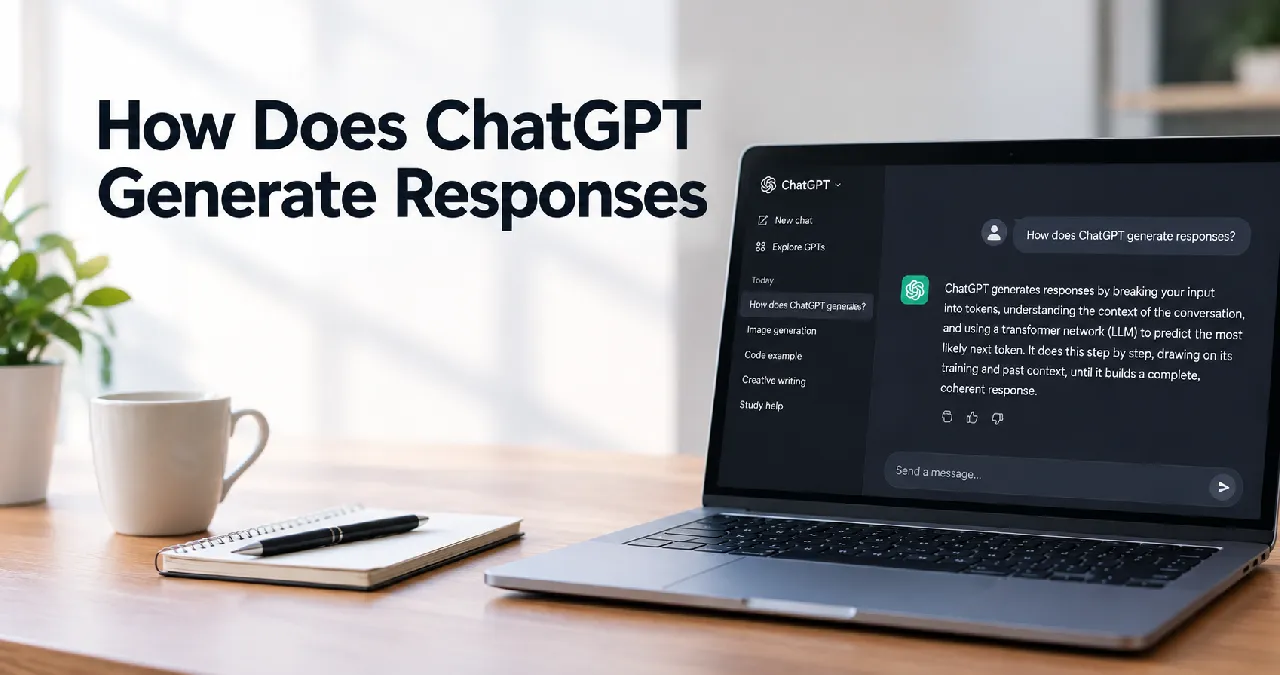
The journey of ChatGPT started as an AI chatbot presently serving as a constant data pipeline by collecting user input and feedback. According to searchengineland, the user base of ChatGPT has over 900 million weekly active users as of February 2026.
At present, users leverage ChatGPT for myriad purposes like writing code, image generation, and solving complex problems. A question definitely pops into mind: how does ChatGPT generate responses to meet all we are looking for? This is perhaps the most remarkable quality ChatGPT offers; besides being an artificial intelligence, it understands human needs and responds accordingly through training by LLMs (Large Language Models).
How Does ChatGPT Generate Responses?
After the user types something in the chat window of ChatGPT, the AI chatbot generates a response simply by breaking the input prompt into tokens. The entire response generation process goes through a transformer network.
Until a complete answer for the prompt is generated, the process of predicting the most likely token continues. The transformer architecture of the LLM model trained for ChatGPT has an impressive ability to retain memory. This, meanwhile, helps to make ChatGPT’s response genuine based on the previous dialogue.
Quick fact box
| ChatGPT knows the human intent from the typed prompt written in everyday language. Next, it comes to context reading, where ChatGPT scans the conversation to know what it actually denotes. The prompt is then divided into small chunks, namely tokens. Next, it comes to LLM processing, where the transformer network fine-tunes the tokens to decide before reaching any final response. The model itself does not know the information upfront; hence calculate the probabilistic token one at a time. The predicted tokens are then concatenated and finally form the complete sentence based on the piece-by-piece buildup. At last, users are shown the final response, and every time it gives freshly assembled information. |
The Response Generation Process, Step by Step
User question
User questions and ChatGPT are basically intertwined as a conversational partner, which is designed to answer user queries. Users use unstructured language to express their needs through a comment prompt. The purpose of ChatGPT is multifaceted and helps with a wider range of tasks.
For instance, you can summarize, organize and research information with ChatGPT. Beyond that, ChatGPT helps users to assist with translations, coding, image generation, and any creative works or ideas. The comment prompt shared by you is analysed by ChatGPT, and it doesn’t require any special syntax; just type in plain text.
Context reading
Before giving genuine information based on the processing of the latest message, the entire conversation was read by ChatGPT. This is the context reading that is helping ChatGPT to generate a response, not just sticking to the previous message. Before answering, it understands the specific intent of the situation and gives personalized responses over generic information.
The full conversation history is read by ChatGPT, helping it to generate a response according to the submitted prompt. Suppose you are searching for the best AI photo generator in 2026. After that, a simple question asking whether it is free or paid gives you information you previously linked with the AI photo generator, without any need to repeat the information. This is how context reading works based on the conversation memory.
Tokenization
The process of breaking a text into adjustable chunks or smaller units is known as tokenization. Each chunk is referred to as a token that is considered the building block of text. The tiny data units are broken into pieces to understand what the language is all about. It may be characters, words, subwords, or even punctuation to help it understand the actual context. Without breaking a sweat, tokenization helps to make ChatGPT understand human language.
LLM processing
The tokenised input is processed by a model known as a neural network architecture. The neural-network architecture produces probability distributions according to the possible next tokens. It doesn’t know the final answer in advance; rather, it builds toward one token by token. The tokenization step is followed by the step where tokens are converted into a response by LLMs. Information is analysed while going through a multi-step pipeline to make human responses that are formed as per context understanding.
Predicting the next token
Before choosing the next token, the AI model of ChatGPT makes a probabilistic calculation based on patterns it learned during the course of training. ChatGPT never makes the full answer for the query in one step.
Response generation
The process of response generation also goes through an iterative cycle of token-by-token consideration. The process of predicting the next token is entirely based on the training given during pattern learning and also on the basis of the context provided.
Final answer
At last, the complete token sequence is transformed into a readable text format. The answer generated based on the prompt is never pre-written. The finally assembled text is built based on the context of the conversation and the prompt you enter.
Where “Knowledge” is actually derived (Pretraining + Fine-Tuning)
The development of an AI model stems from pretraining. The word P in GPT itself denotes “pre-trained.” Extensive training enables ChatGPT to acquire a large amount of data from the internet. The model is taught with a massive amount of information retrieved from books, articles, websites, and code.
The extensive training benchmarks enable the model to acquire linguistic patterns, grammar understanding, and, above all, learn about semantics. In this phase, the AI chatbot received unsupervised training, which is the foundational phase to read raw data and gather knowledge. After the initial training process ended, the model went through a process of fine-tuning. The adjustment & evaluation of the model are handled by human trainers. The entire process helps ChatGPT generate accurate, contextual answers for every query.
Read more: ChatGPT vs Grok.
Final wrap
The response generation by ChatGPT goes through a myriad of steps. It is not actually a single-step process but involves multiple computational steps to generate the response in just seconds.
Frequently asked questions (FAQs)
No, unlike human ChatGPT does not think, but the reasoning models and thinking modes are working to execute the process to showcase internal steps before displaying an answer.
Yes, as long as your account is open, ChatGPT can, by default, save the past conversation history.