
IT stands for Information Technology. We need to know it deeply rather than at a surface level. Information technology is defined as a subset of technology that leverages networks, storage devices, and computers for creating, processing, storing, and exchanging electronic data.
In the age of information and communication technology (ICT), knowing the acronym of IT is not sufficient, right? Information technology is a broad term that is instrumental for safeguarding data from unauthorized access and forgery. It, meanwhile, helps to troubleshoot computer hardware problems and to reframe communication networks.
In this digital piece, I will shed light on why IT matters, its role in daily life, and whether it is prudent to choose IT as a career. Let’s dive in.
Why Information Technology (IT) matters
From waking up in the morning to retiring to our beds at night, we cannot imagine anything without our smartphone or computer. People are scrolling on their digital devices every time they are searching for social media updates, making online payments, or sending mail. In commerce, accounting, finance, and HR management, everything is effortlessly managed due to the boon of IT. This is why Information Technology (IT) matters most, from our personal use to commercial pursuits.
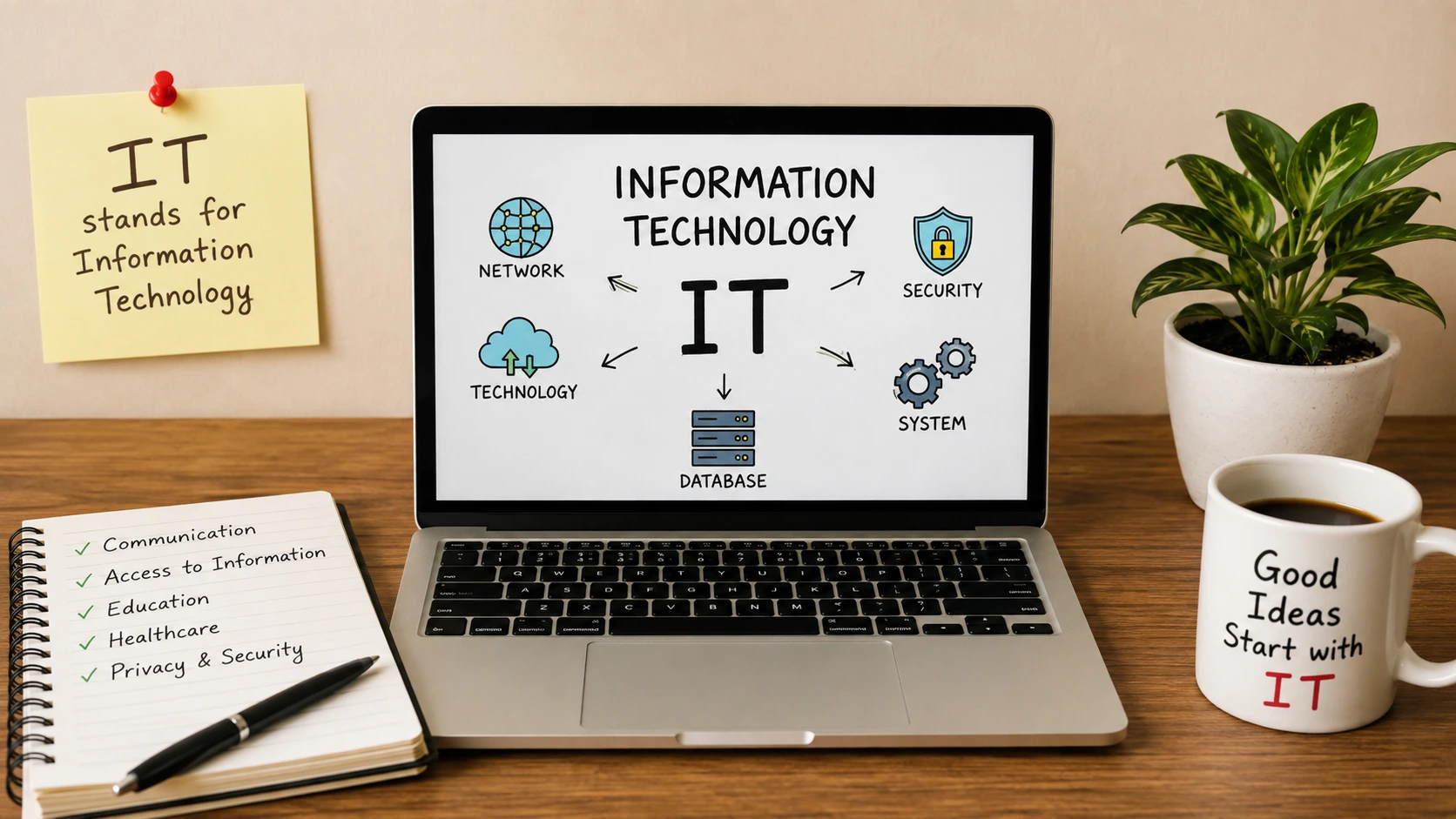
Besides our every scroll, upload, and online stream, there is an invisible backbone, IT, that makes the connection possible for our needs. According to the Datareportal website, 5.79 billion users are identified as using social media every month at the start of April 2026. Meanwhile, it implies how the IT-powered platform is becoming inextricably linked to our necessities.
Data control becomes increasingly easier as digital files demand less space compared to physical storage, saving the precious time we invest in saving and storing data without losing the invaluable information. The growth of information technology is skyrocketing, necessitating greater technological literacy to participate in the demanding conversation and find appropriate solutions to excel.
Let’s picture a situation by yourself. A few decades back, you were waiting to enjoy your favourite show either by waiting for the time slot to enjoy the show or just renting a DVD. Kudos to the developer who made it seemingly easier for us to enjoy our favourite show at our convenience 24/7 without any wait on Netflix or Hotstar. This is not magic, but IT working in the background to make the impossible possible.
Information Technology in Everyday Life
Information technology is interwoven into our everyday lives. Supposedly you are using your phone to open an app and save anything from your phone to your device’s gallery. How does it happen? This is exactly how IT works in the background. It is indeed helpful for storing data, processing it, and giving the result instantly without any delay.
From shopping for our needful accessories on e-commerce to watching our favourite movie on a streaming site, data is moving constantly, giving results in real time. Let’s have a look at myriad areas that tremendously benefit by embracing IT.
| Areas in our life benefited by IT | How does it happen |
| Communication | Communication becomes faster by embracing IT, which ensures faster email transmission. Meanwhile, it helps in instant messaging and handling video conferencing (Zoom and Skype) in a sleek and effortless manner. |
| Access to Information | Search engines like Google, Bing & Yahoo provide vast amounts of information at our fingertips. This is IT working behind the scenes. |
| Education | IT has brought educational transformation through Learning Management Systems (LMS) like Moodle and Blackboard, virtual classrooms, and online educational tutorials. |
| Healthcare | Technologies such as Electronic Health Records (EHRs), telemedicine, and advanced medical imaging enhance patient care and enable consultation remotely. |
| Privacy & Security | Encryption, multi-factor authentication, and data protection regulations such as GDPR help safeguard sensitive information from forgery & unauthorized access. |
Is a Career in IT a Good Choice
There are a plethora of options available for kickstarting a career in the IT industry. If you are a newcomer or someone who opts to make a change in your career, the IT industry offers countless options to explore your career, listed at the top. The IT industry is the fastest-growing sector that delivers quick employment, high salaries, and growth.
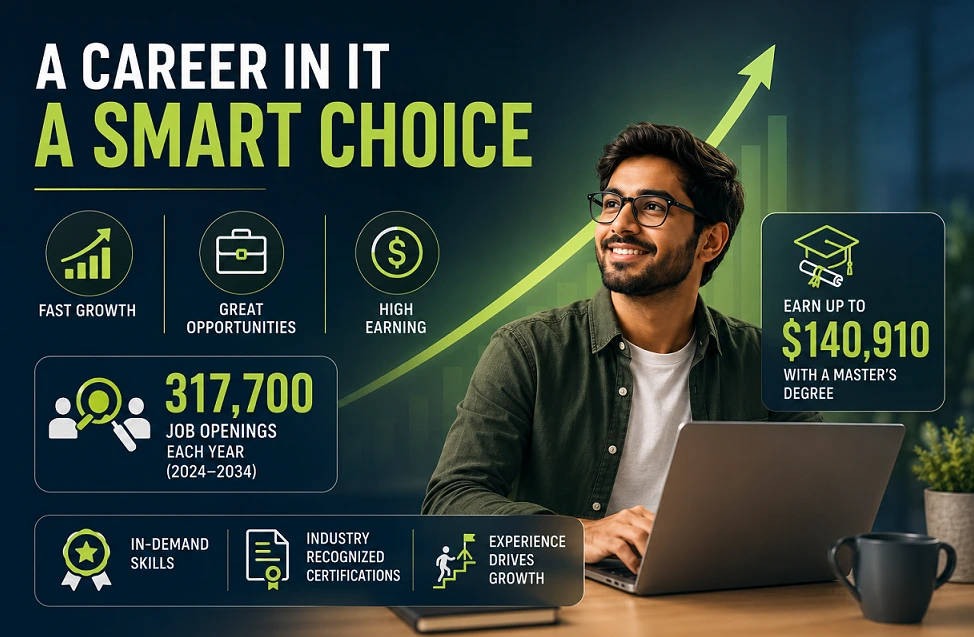
According to the US Bureau of Labor Statistics, 317,700 openings are projected to come into place each year from 2024 to the year 2034 in the occupation of computer and information technology. IT is not a siloed industry; rather, it perfectly overlaps with other industries, making it ideal for exploring multiple career options in the niche.
The tech skills of an IT professional are invaluable assets, helping to secure lucrative packages for their IT career. Computer and Information Research Scientists in the US earn $140,910 with a master’s degree as an eligibility benchmark for the job. Skill set, certification, and years of experience are the deciding factors in managing salary ranges.
Degrees, certifications, entry-level roles with IT as a career
| Entry-level Role with IT | Educational qualification | Certification | Key Skills | Avg. Pay |
| Help Desk Technician | No formal degree needed | Having certification in IT is helpful | Troubleshooting, tech support | $64K |
| Desktop Support Specialist | HS diploma / Associate degree | CompTIA A+ | Hardware, OS, hands-on fixes | $74K |
| Technical Support Specialist | HS diploma | Technical certification provides edge | Communication, customer service | $72K |
| Junior Network Technician | Associate degree | CompTIA Network+ | Networking, TCP/IP | $79K |
| IT Support Specialist | HS diploma | CompTIA A+ | Generalist troubleshooting, problem-solving | $71K |
Final notes
IT is becoming an indispensable field influencing the way we shop from e-commerce to streaming shows online. The importance of IT is never overstated, as it influences everything from our daily necessities to office work. It does not matter whether you are a learner who wants to learn it for knowledge or someone who is intending to upskill; learning IT is a judicious move.
Frequently asked questions (FAQs)
Choosing a career in IT is a great choice as it offers competitive pay, job growth and better flexibility to work. Although the entry-level job hiring demand is high, if one upskills properly, one can expect growth over time.
Computer science is the discipline that develops the theoretical foundation to learn computing, coding, algorithms, and software development. IT, on the other hand, refers to the knowledge of management and implementation of technology to assist a business in running and functioning accordingly.
No, it is not necessary to hold a degree to secure an entry-level job in IT. Job profiles like desk technician, desktop support, or computer repair are based on practical skills and hands-on knowledge rather than having a college diploma.