
Generative AI has a far-reaching impact on digital content creation; it serves as a stepping stone and can tremendously influence text and image creation, video and audio production, and any activity that creates digital content. Suppose you want to turn a written scene into a short clip; the question pops into your head: how, right? Tools like Sora, Runway, and others can do this.
This is exactly where the relevance of generative AI models comes in. Generative AI is a form of artificial intelligence that can make text, images, audio, and video content based on a given prompt. The model is already fed with an enormous amount of video data matched with descriptions. Now the question is whether the model produces accurate, useful output. Read the article to learn the common challenges generative AI faces with respect to data and how to mitigate them.
Why Is Data So Important to Generative AI?
AI can speed up work and improve decisions, but only if the data behind it is good. Now the catch is: what about the data you use? Suppose your data are obsolete, messy and scattered. You will not get reliable results and will eventually break people’s trust. Poor data quality causes wrong answers. Poor data handling can cause privacy breaches.
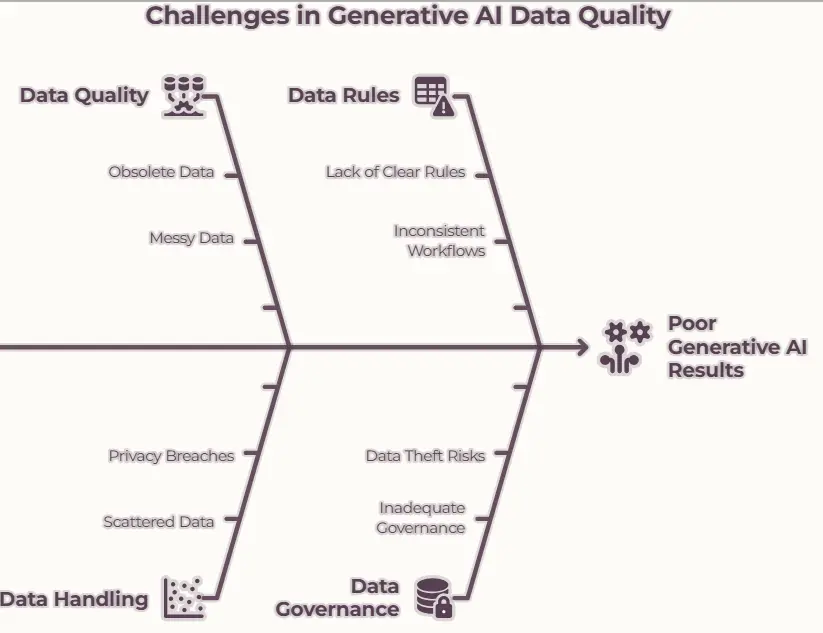
Clear data rules must be set before training. They lead to smoother workflows and more accurate answers. Data governance and stewardship are important facets to safeguard against data theft.
For instance, Forbes reported that Samsung in May 2023 banned the use of generative AI tools like ChatGPT. This is because of the staff data leakage that was revealed after the confidential internal source code was stored on a third-party server. Employees pasted internal source code into ChatGPT. According to Bloomberg, Samsung worried the data was stored on external servers and was hard to retrieve or delete, so it restricted the tools.
Samsung Incident 2023
| Aspect | Details |
| Company | Samsung |
| Date | May 2023 |
| Incident | Employees shared sensitive code with ChatGPT |
| Risk | Company data could be exposed through external AI services |
| Response | Samsung restricted generative AI tools on company devices |
| Lesson | Create clear rules for what employees can share with AI |
Challenges that generative AI faces with respect to data
There are a plethora of challenges that may be encountered by generative AI with respect to data. Let’s go through the table to understand the challenge and why it is a problem for generative AI, followed by its impact.
| Challenge | Why it is a problem for generative AI | Impact |
| Low-Quality Data | Training data contains myriad errors, duplicates, gaps, or irrelevant content. | Produces inaccurate answers. |
| High Cost | Collecting, storing, processing, and labelling datasets requires higher costs. | Creates barriers for smaller teams. |
| Misinformation | AI-generated images, text, audio, and video may enable deceptive content creation. | May cause scams, misinformation, and loss of public trust. |
| Security Threats | Attackers may insert malicious data, leading to data poisoning. | Can render hidden vulnerabilities or cause breaches. |
| Stale Information | Real-world information changes after the model has been trained. | May generate less accurate responses over time. |
| Biased or Narrow Data | Certain languages or viewpoints are underrepresented. | Can lead to uneven performance. |
| Privacy Exposure | Personal information may enter training datasets. | Creates risks of data leaks and privacy-law violations. |
| Copyright | The source, ownership, or licensing of training content may be unclear. | Leads to copyright disputes and legal challenges. |
| Scattered and Messy Business Data | Important information is spread across PDFs, emails, databases, and other silos. | AI may misinterpret context when using key information. |
| Weak Data Governance | There are no clear rules, owners, controls, or audit trails for data. | Makes errors difficult to identify and rectify |
How to Overcome Data Challenges in Generative AI
Organisations that are adept and know well how to manage data proactively and leverage AI are always far-reaching in the competition. Generative AI models must be trained with legally obtainable datasets and licensed proprietary data. They should never indulge in web content scraping without prior permission.
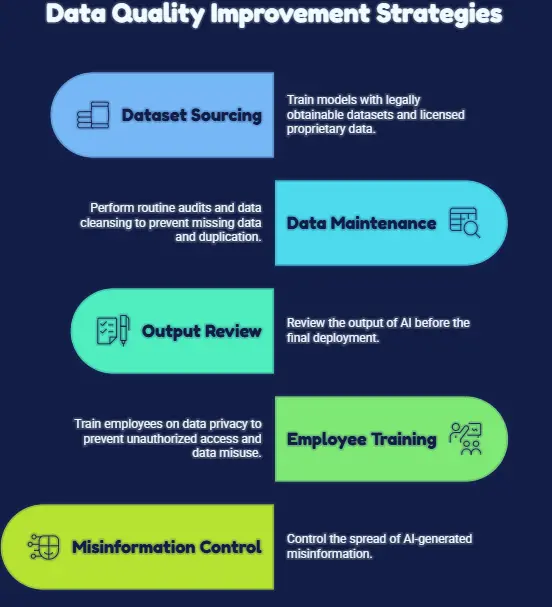
Routine audits and data cleansing help to guard against missing data and duplication problems. Reviewing the output of AI is crucial before the final deployment. Employee training on data privacy helps them to understand how data are vulnerable to unauthorised access and prone to data misuse. The spread of AI-generated misinformation needs to be controlled. This is how Data Quality is substantially improved.
Wrapping up
The functioning of generative AI entirely depends upon the quality of data that has been fed into it. Low-quality data, feeble data governance, privacy exposure, and uncertainty due to copyright have turned a promising tool into a vulnerable one. The 2023 Samsung incident is a clear reminder of the serious risk that can cause serious backlash or may pose harm to larger companies if data rules are missing. Start current data auditing, set clear rules for how it is used, and build from that point.