
AI humanizers are marketed as a solution for writing professionals, helping them to produce humanized text generated by AI. Its motto is simple: helping you to bypass AI detection by making AI content sound human-written.
But does it really work, or is it something that makes the thing difficult to achieve? Read on the Webtechhelp blog to know whether AI humanizers truly work or are easily spotted by the AI detector. So, without further ado, let’s proceed to learn about it. No circumlocution, just the real talk with no fluff.
The Short Answer: Why AI Humanizers Don’t Work
There are a plethora of tools that claim to deliver humanised content without any AI detection guarantee, to provide AI-undetectable text. Despite this, AI Humanizers Don’t Work and fail to deliver what they are truly intended to give. Now the question definitely pops into your mind: what does it actually do then, right?
They are actually involved in doing a synonym swap and shuffle of sentences rather than being able to meticulously alter the statistical pattern of AI text. That’s why it is often seen that AI Humanizers fall short of fooling the modern AI detectors.
How AI Humanizers Actually Work
👍 Synonym replacement
Here, in the AI text, the Humanizers make a synonym swap to convert AI-written versions to human-written content. This is how the synonym swapping changes vocabulary, but the tone of writing remains intact.
👍 Injection of perplexity
While transforming AI-generated text into a humanised version, deliberate randomness is incorporated to simulate the natural style of human writing. Here, injection of perplexity is done by adding structural irregularities through minor grammatical quirks to make it look less AI-generated.
👍Sentence restructuring
During sentence restructuring, the longer sentence is broken into smaller ones. Clause reordering and adding structural variation are other tweaks seen in the work mechanism of AI humanizers. Sentence burstiness helps AI humanizers gauge the variation in sentence length and bypass AI detection.
👍 Adding fillers
To mimic the natural human voice, tone, and rigour of writing, AI humanizers are forging language statistics, bringing manipulation to bypass AI detection. The result? Content looks human-written, not AI-generated.
| Let’s have a look at the example to know Actually Work process of an AI humanizer “Original AI text made by Claude: Human Resource Management (HRM) is the strategic approach to managing an organization’s most valuable asset: its people. It covers all activities related to recruiting, developing, motivating, and retaining employees so that they contribute effectively to the company’s goals. After running through a typical humanizer, namely StealthWriter AI: Human Resource Management (HRM) is the strategic management of human resources and is the most precious asset of the organization. It involves recruitment, training, motivation and retention of people to ensure that they can work effectively towards the achievement of the company’s goals. |
I Ran Humanized Text Through AI Detectors. Here’s What Actually Happened
AI Humanizers are basically paraphrasers; their algorithms quickly read & scan the AI-generated text and make the text humanised. They perform synonym swapping and sentence shuffling to scrape the text written by AI but are hardly able to alter the statistical fingerprint of the AI text you copy and paste on ai Humanizer.
Let me simplify this for you. I have copied the text of some lines from Claude about HRM and pasted the same written part into StealthWriter AI to bypass AI detection. After running it on the tool, it ensures my text is 100% human-written, as per the detection score from StealthWriter AI. Then I cross-checked what the scenario actually is. I pasted the humanized text on zero GPT that content detected with 48.2 % AI. This is exactly what I actually witnessed while ran Humanized Text Through AI Detector.
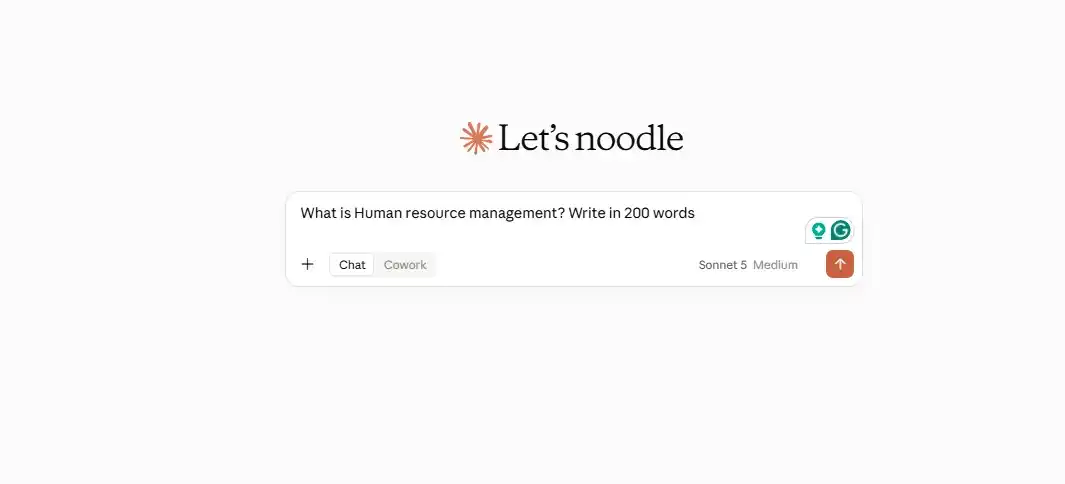
✔️At first, I generated an AI text on Claude by asking what human resource management is, and it generated an AI answer.

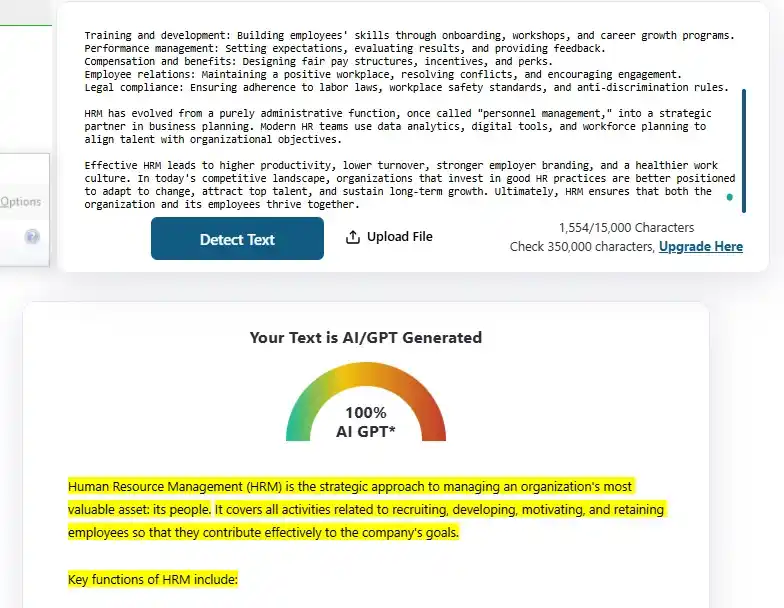
✔️ After directly pasting the Claude-generated text into ZeroGPT for AI detection, the score shows 100% AI.
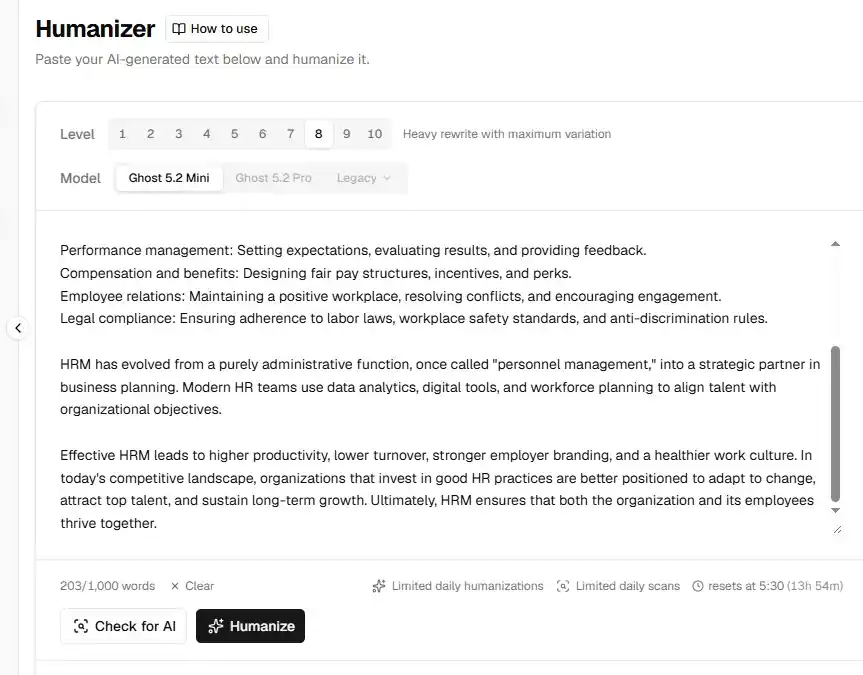
✔️ Then I pasted AI -sourced content into an AI humanizer named StealthWriter AI.
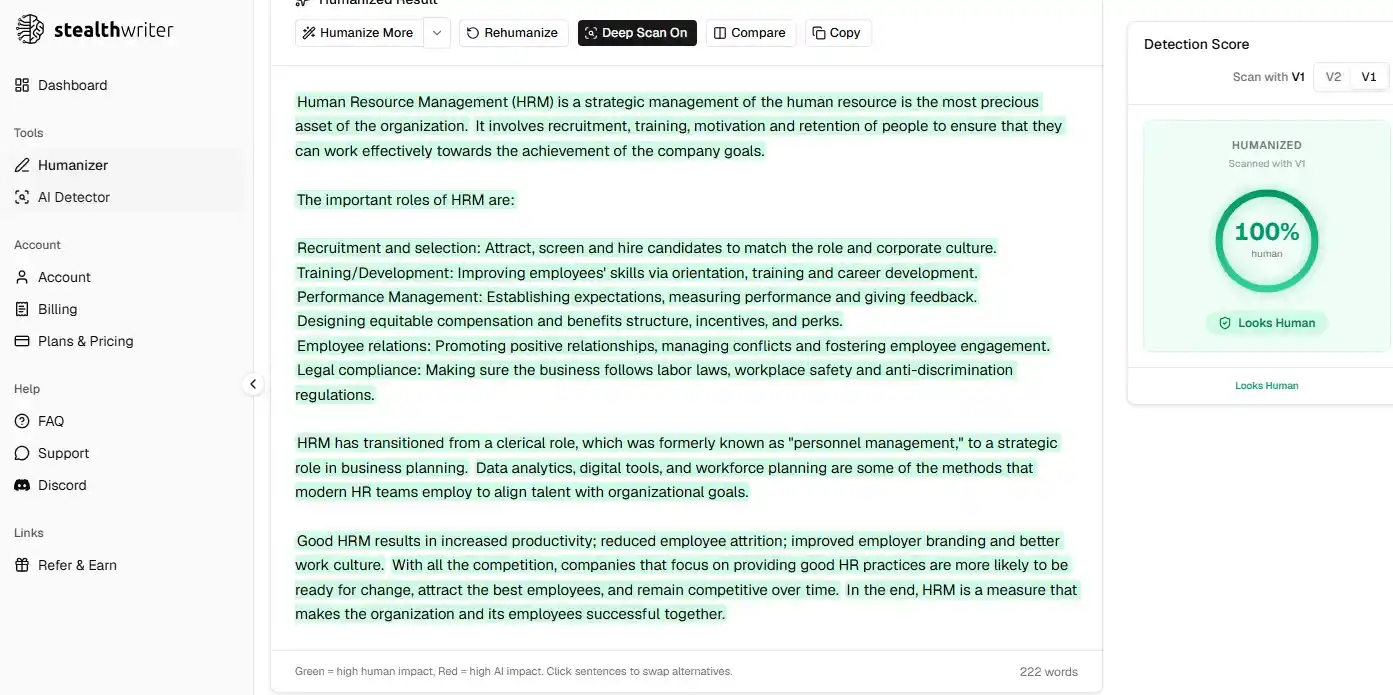
✔️ Next, I ran the pasted text through the StealthWriter AI detection tool to check the detection score, revealing the content as 100% human-written.
✔️ Next, check the actual instance of the AI detection results. Now I pasted the humanized version of Claude-generated text into the AI detection tool zero GPT that shows my text is flagged at 48.2% AI. AI humanizers don’t work reliably. They lower scores but don’t guarantee a pass.
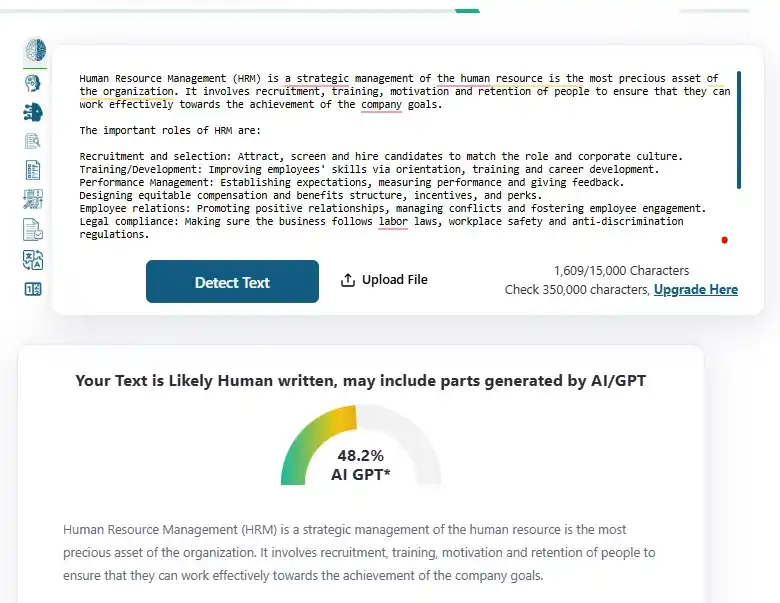
I presented one of the scenarios of an AI detection reality check. The rest of the leftover plethora of AI humanizer tools are also unable to make content entirely human-written and avoid flagged content, just as it does.
Example table of what actually happened above
| Stage | Tool/content | Result | What it shows |
| 1 | Claude-generated text | 100% AI on ZeroGPT | Baseline AI-generated text |
| 2 | StealthWriter humanizer | 100% human on StealthWriter | Humanizer’s own detector accepted the rewrite |
| 3 | Humanized text tested on ZeroGPT | 48.2% AI | Detector results can differ significantly |
Why humanizers fail to stop content from being flagged by detectors
There are a plethora of reasons why humanizers fail to stop content from being flagged by detectors. Go through the table below to learn about it.
| Why humanizers fail | What happens |
| Change words, not patterns | Synonym swaps leave perplexity and burstiness unchanged |
| Detectors retrain on them | Humanizer output becomes a known fingerprint |
| Detectors disagree | Same text passes one tool, fails another |
| Rewrite is too light or too heavy | Structure survives, or meaning gets damaged |
| Add their own tells | Stiff wording and rigid structure can raise the score |
| No real human input | No experience, opinion, or specific detail |
| Built to beat algorithms | Lower score, but text still reads generic |
What about ranking: does humanized content rank on Google
Google always prioritises content quality rather than the way of content production process. Content quality and originality are the factors that Google always brings under consideration for rewarding. According to Google, to make content rewarding, the content must fulfil E-E-A-T as a lens of quality for people-first, high-quality content.
Bottom line
AI humanizers don’t work because they know how to change the wording but aren’t competent enough to change the pattern underneath. It is needless to say that sentence shuffling and synonym swaps lessen AI detection scores but do not fully remove them.
This is exactly why the Claude-generated AI text after humanizing scored 100% human on StealthWriter but in reality flagged 48.2% AI on ZeroGPT.Google only gives rewards for the content that shows real value to the reader, no matter what. So in the end, it is worthwhile to use first-hand experience, screenshots, and your own writing to produce content that is entirely your own without involving the humanizer tool.