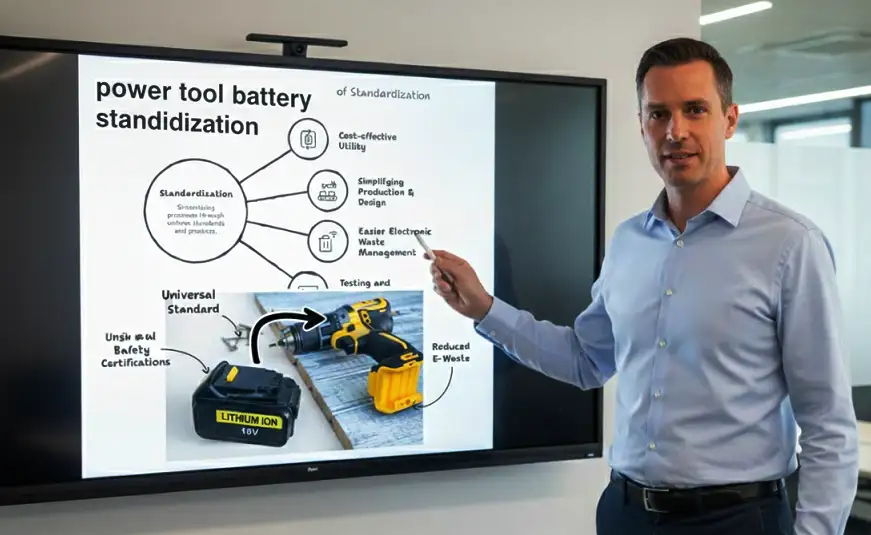
Power Tool Battery Standardization is becoming an invaluable need for many professionals and DIY enthusiasts who often struggle with the lack of usage of power tools with incompatible batteries. Sounds frustrating, right?
This is how power tool battery standardization will evolve as a genuine solution that will help to reduce the electronic waste generation and eliminate duplicate battery purchases. Go through the blog to catch everything you need to know for this battery standardization system.
Why power tool battery standardization-fact unfolded
The power tool industry has experienced a dramatic upsurge with battery-led technology in recent times. Demand for cordless tools has gained attention across manufacturing, construction, home-based DIY project and many more domains. The emergence of cordless tool come forward with newer obstacles and challenges like never before.
Battery incompatibility is becoming a cause of caution. It is evident to know the role of each brand who design its own chargers. It meanwhile lets the proprietary battery ecosystem bind users in a closed loop. Suppose you purchase a battery with a drill from any X brand, never let you any way for sourcing sanders & saws from brand Y as replacement.
Meaning, it is becoming the actual cause behind higher costs with significant waste generation. Interoperability is the prime reason behind such an issue. To overcome issues like this, power tool battery standardization is becoming a crying need for many professionals. To know more exactly what it’s all about, let’s roll.
Why Standardization Became an Undeniable Necessity
Myriad factors make power tool battery standardization an undeniable necessity. To know the factor behind, let’s have a look at the points mentioned below with justification.
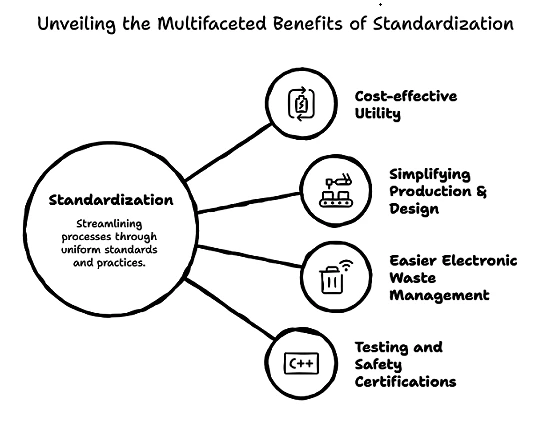
👉 Cost-effective utility: There is no relevance to duplicate your investment by indulging in unnecessary purchases of various batteries. I think you agree that there is no rationality if a professional has dozens of batteries that mostly end up with no utilization. Hence, the concept of standardization comes forward, which reduces the recurring costs that mostly come from allowing the use of a pool of batteries to power all the requisite tools.
👉 Simplifying production & design: Efficiency improvement and cost reduction are driving the manufacturers to feel more satisfied. The design and production simplification through standardization doesn’t create trouble for manufacturers, as it aids in less dependence on different types of battery formats. So the manufacturer can only make optimizations for fewer designs that curtail the overall cost of manufacturing.
👉 Easier Electronic waste management: Incompatible batteries that are annually produced are in billions in numbers. Meanwhile, these are mostly lithium-ion made cause electric waste generation. Lack of standardization makes them obsolete before reaching the actual maturation phase. The advocacy by the government and environmental responsible groups somehow makes their way forward to leverage standardization to reduce the overall electronic waste.
👉 Testing and safety certifications to guarantee user safety: Sometimes, unsafe or counterfeit batteries cause safety compromises, necessitating the need to embrace testing and safety certifications to guarantee user safety.
Market Adoption insight
Embracing power tool battery standardization is a gradual yet steady process. From the early 2010s to mid 2010s, there has been a dynamic shift that influences market adoption. The accelerated adoption rate brings multiple brands under a unified battery platform that was only possible with the standardized adoption of power tools.
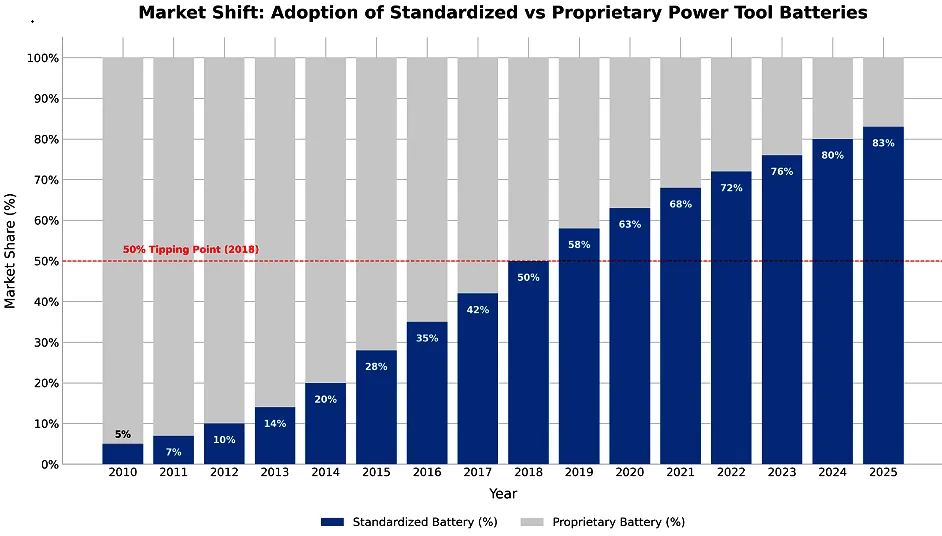
The bar graph illustrated above shows a hypothetical dataset to address the market share for proprietary vs standardized batteries, ranging from 2010 to 2025.
Data insight revealed by the bar graph is described below in a tabular format.
| Category | Data Insight |
| Initial Market Position | 95% Proprietary, while 5% Standardized |
| Tipping Point | 2018 (50% share each) |
| Current Leader as of 2025 | Standardized Battery (83%) |
| Growth upsurge for the standardized tool over 15 years span. | +78% Market Share gain from 5% to 83%. |
| Decline for the proprietary system | Dropped from 95% to 17% |
Pros and cons of battery standardization
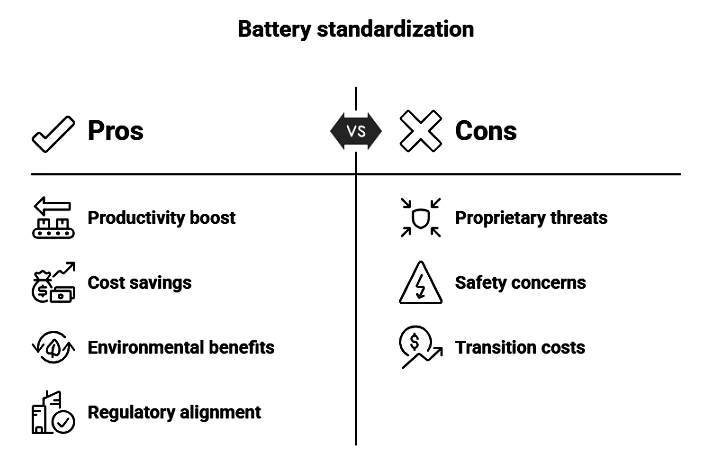
Let’s have a look at some pros and cons of power tool battery standardization, mentioned with justification.
Pros
👉 Productivity improvement with minimal downtime: It is an undeniable truth that time is money. Wasting time is entirely intolerable that is met well when we adopt battery standardization. So, embracing standardization won’t let workers carry multiple chargers for their batteries. Hence, it is noteworthy that interchangeability is ideal for production efficiency and the reduction of downtime.
👉 Cost-effective: In terms of reducing the ownership costs, the standardization comes forward as a breakthrough that saves frustration stemming from incompatible battery packs.
👉 Environmentally viable: Adopting standardization helps to lower the impact of electronic waste generation. Environmental awareness is invaluable no matter what. Taking a pledge to implement the 3R (reduce, reuse, recycle) in Battery standardization would become significant in lowering the electronic waste generation.
👉 Regulatory benchmark alignment: Government involvement to set regularly benchmark help to position the standardization approach more responsibly and in a regulated manner.
Cons
👉 Threatens Proprietary ecosystems: The proprietor makes a lock-in ecosystem to influence repeat purchase and acquire a loyal customer base. This is exactly where the standardization acts as a direct threat to the exclusivity run by Proprietary systems.
👉 Safety & Liability concern: Explosion, overheating, and fire can directly damage the battery if not handled carefully.
👉 Upsurge of Transition Costs: The industry transition from proprietary ecosystems to a standardization ecosystem doesn’t happen overnight. So there would be a transition cost that would become a matter necessitating further rethinking for adoption.
Wrapping up
Power tool battery standardization has come forward as a new name in the contemporary ecosystem. For consumers, it is the ultimate gateway that guarantees convenience, cost-savings, and sustainability. If you consider the environmental aspect, it is the ultimate benchmark that plays a crucial role in e-waste handling and lowering the carbon footprint.
The power tool ecosystem drives innovation while creating challenges for manufacturing, as it transitions from proprietary ecosystems to a standardization ecosystem. Let’s see how it evolves and becomes the defining gateway for the power tool ecosystem.
Frequently asked questions (FAQs)
Standardized batteries are easily refurbished, making them ideal for recycling and reselling. Hence, it is quite obvious that lowering electronic waste from the power tool industry is backed up by standardized batteries.
Battery standardization plays an important role in regulating the heat generation and dissipation process to meet the benchmarks for thermal management in the power tool industry.