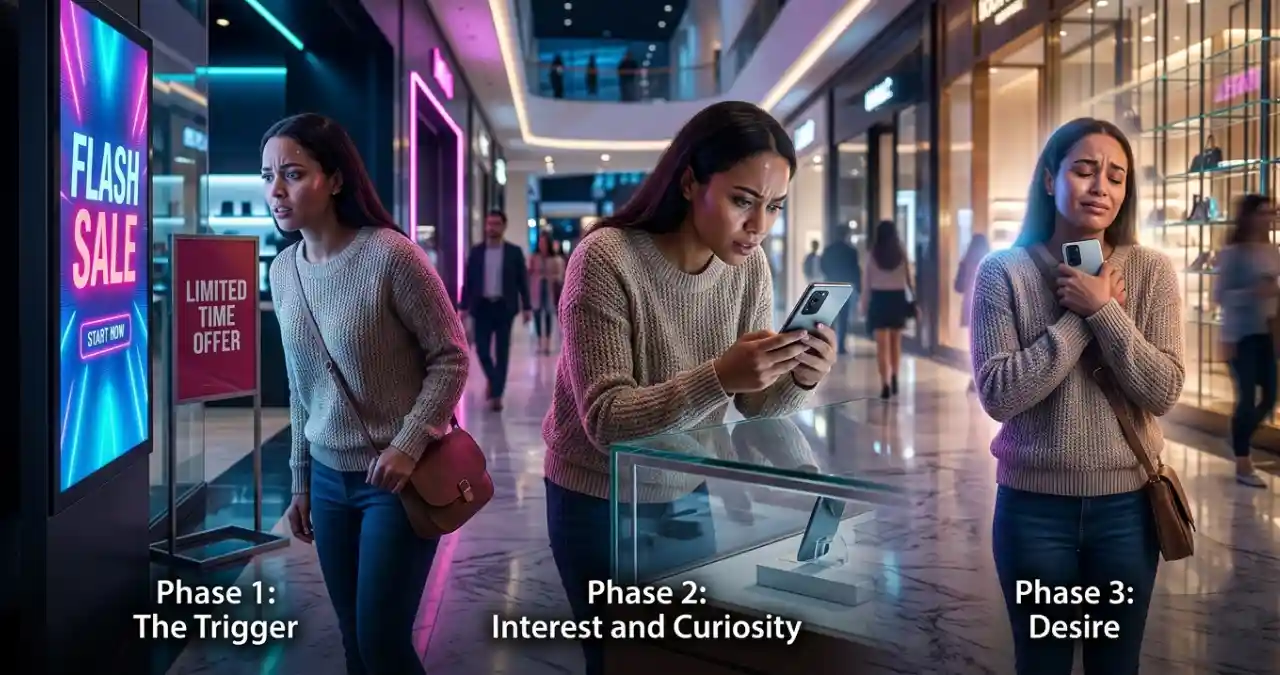
Have you ever experienced purchasing something unintended while opting to buy something that would never be in your add-to-cart list? Let me describe this. Supposedly, you are going to purchase your groceries by making a shopping list as per your mindset, but suddenly purchase something unplanned, driven by emotion.
If you have faced this once in a while or many times while shopping, you are not alone. It is your uncontrollable impulse to act on a whim. Here’s how the concept of impulse purchase arises. An impulse purchase is nothing but an uncontrolled urge driven by emotion to purchase without letting your mind make any rational choice.
According to leading global press, PR Newswire, “Over half of Americans have spent $100 or more on an impulse buy (54%)”. In this Webtechhelp blog, I will give a revealing guide to detour buying fueled by emotions by shedding light on three of the seven phases of the impulse purchase cycle. Let’s dwell on the blog to know about impulse buying, factors that influence it, how to avoid them, and much more.
What Is Impulse Buying?
Impulse buying is an emotional compulsion that drives a person to override their rational decision-making prowess, making them purchase something that is often beyond their budget. It does not mean an individual lacks willpower, but actually happens because of a myriad of neuro-biochemical responses influenced by emotion.
It is often seen that a sudden release of the dopamine hormone gives a temporary feeling of joy while buying something unplanned. Although they seem difficult to break the biological pattern of emotional drive, it is quite easy to overcome it by practicing mindful shopping with no whim.
What is the Impulse Purchase Cycle?
The impulse purchase cycle is a biological process that triggers an individual to purchase in the blink of an eye, fueled by emotions rather than prioritizing any solid reason. Let’s explain. Suppose you are going to the electronics shop to purchase a laptop. Suddenly, a last-minute deal offering a 70% discount on the price grabbed your attention to a mobile phone.
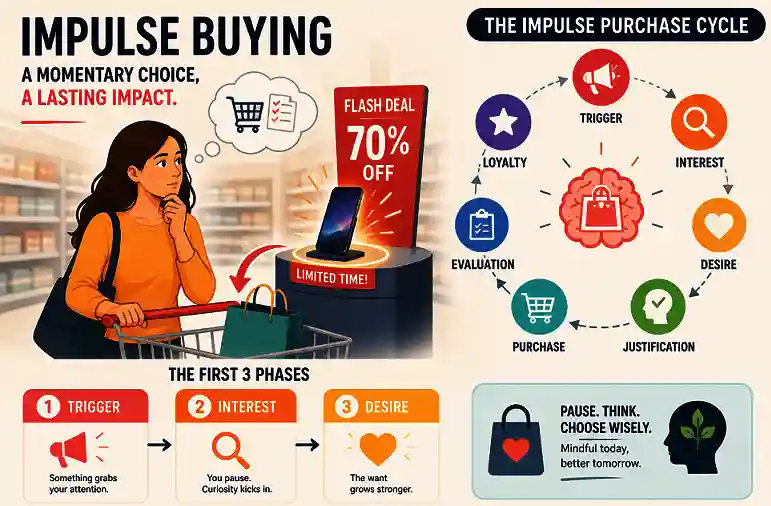
Although you are initially not inclined to buy it, you add the product to your shopping cart on a whim with no second thought. You don’t even give enough time to consider whether it is a brand-new product or a refurbished product that won’t last long. It’s your fleeting impulse driven by emotion that compelled you to do the purchase, no matter what.
That’s why the impulse purchase has become an important concept, you become curious to know more about. It is your choice to fulfill your instant gratification, where your mind plays a little to no role in decision-making. Knowing the impulse purchase cycle is important to keep yourself unencumbered from the harmful patterns. The Impulse Cycle comprises seven steps.
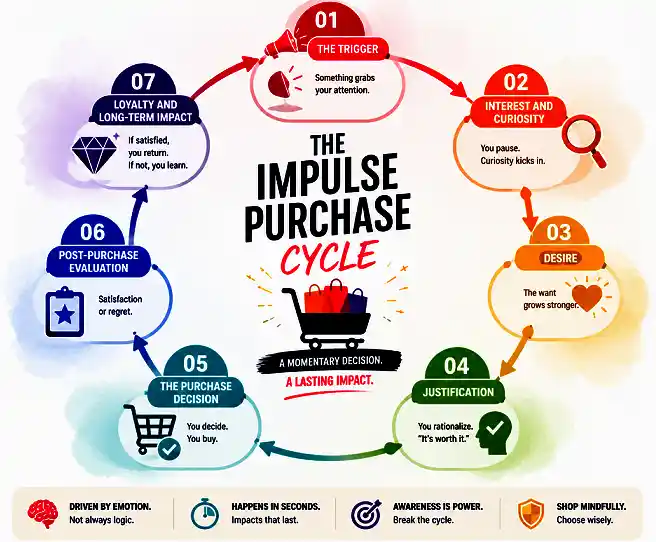
Phase 1: The Trigger
Phase 2: Interest And Curiosity
Phase 3: Desire
Phase 4: Justification
Phase 5: The Purchase Decision
Phase 6: Post-Purchase Evaluation
Phase 7: Loyalty And Long-Term Impact
Among the seven phases of the impulse purchase cycle, I only shed light on three phases of it in the blog in a lucid and easy-to-understand way for you. So why late? Let’s roll in the latter part to discover it.
Three Phases of the Impulse Purchase Cycle
Among the seven phases of the impulse purchase cycle, let’s delve into three exciting phases of it in this section.
Phase 1: The Trigger
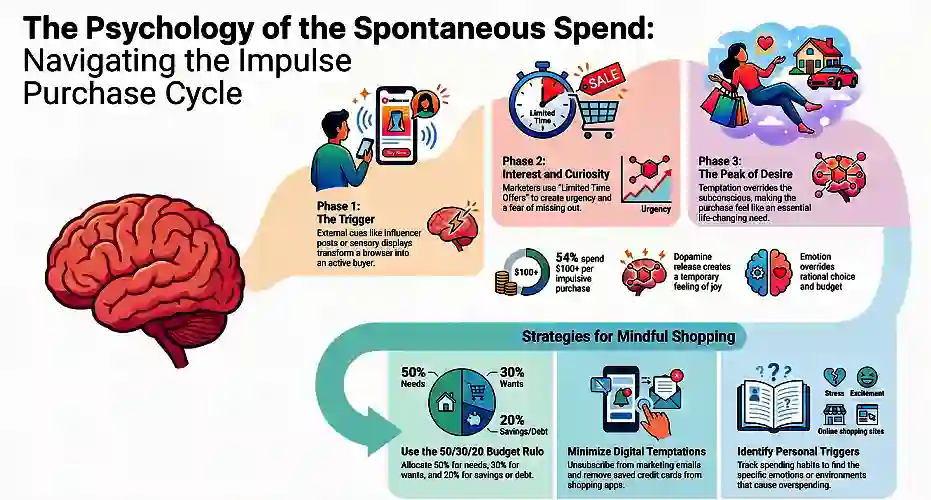
Are you seeing your peers or any influencers to purchase something that ignites a desire to buy that specific thing? Are you mesmerized by the LCD’s colorful display or by the popcorn smell from the movie theater that only heightens your desire for it? It’s nothing but a trigger that catches your interest to have it. From a buyer’s perspective, it’s time to transition from casual browsing to buying.
The cycle of impulse purchase stems from an unexpected product encounter at the trigger phase that holds your attention, and you grab it before any intervention led by your subconscious mind. To stop purchases fueled by triggers, you need to stop browsing your phone unnecessarily while bored and unsubscribe from marketing emails to never be lured towards unplanned purchases.
Phase 2: Interest And Curiosity
After the product enthralls your attention to have it, everything would start to fade away. It means you had a strong interest in having it. Have you ever felt stunned by any TV ads that make you feel fuzzy? If yes, it means the ads are capable of establishing a connection with their products with you through their storytelling and visual appeal.
Marketers sometimes publicize their product by using powerful words like “limited time deal” and “one-time offer” to create a sense of urgency that makes you feel a deep fear of missing out. This is how your interest started to grow, making you a buyer from a casual browser. This is how marketers play the game to boost your interest in purchasing it.
Phase 3: Desire
Desire is the phase of the impulse purchase cycle when you cannot resist your temptation to have it, no matter what. It acts as a psychological hack that intervenes in your subconscious mind to prevent you from thinking without the product. Purchasing the product would become your ultimate vision. You may start to feel that purchasing the product would change your life. It’s become a strong feeling to have it at any cost.
How to Avoid Impulse during Shopping
Impulse shopping would become a real red flag if adequate measures are not taken. Let’s go through the points in the table to know how to avoid Impulse during shopping.
| Strategy | Key Actions taken |
| Track Spending Habits | Identify the triggers that raise your overspending habit. It may be your credit cards to pay for shopping bills. Be honest about why you overspend. |
| Set a Budget | Use the 50/30/20 rule: 50% needs, 30% wants, 20% savings/debt. Setting a realistic budget without indulging emotion can lead to mindful shopping with no whim. |
| Practice Mindfulness | Try to work on consumerist urges to never spend any money unnecessarily. |
| Minimize Temptation | Avoid triggering stores/malls. Replace shopping time with hobbies. Also, try to remove saved cards from apps for one-click buys |
Conclusion
Impulsive buying is an emotionally driven, unplanned habit that needs to be worked on to improve mindful shopping behaviour. Initially, it seems intimidating, but gradually, having a positive mindset and following the concrete steps helps one to overcome the trouble deliberately.
In the article, we discuss the three important phases of the impulse purchase cycle that drive our inclination for unplanned purchases. We make out how it ignites a desire to buy and how to avoid the real red flags of impulsive shopping. Developing the habit of mindful shopping requires identifying the trigger and resisting its steadfast deployment to save money for necessity & hardship.