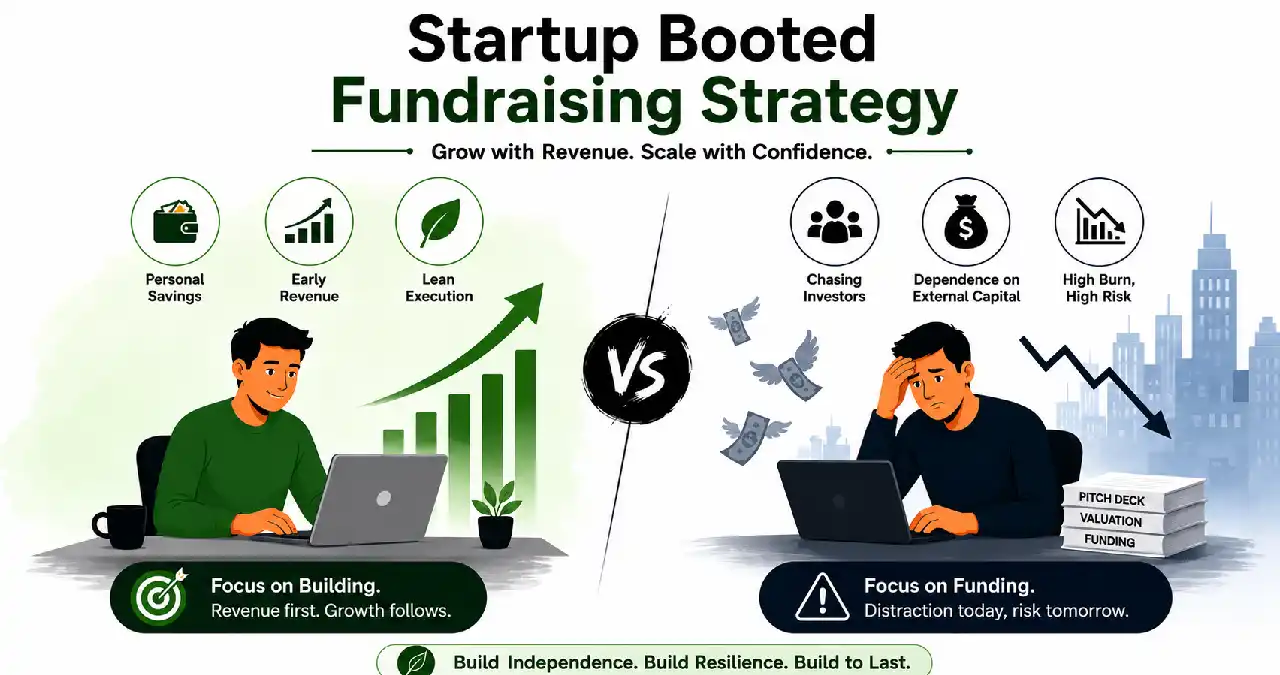
While many business ventures entirely depend upon the initial capital for launching a start-up with venture capital and angel investors, there is something unique in Startup Booted Fundraising. It is nothing but a self‑funded initiative that flips the entire narrative to run a business. Unlike outside funding, this approach provides the momentum to the business by investment from the founders themselves to gain customer validation and succeed with unwavering commitment to fundraising.
What Is a Startup Booted Fundraising Strategy?
Startup Booted Fundraising Strategy is a way for raising business funds on the basis of early revenue from customers, personal savings, and lean activity of the business, with no dependence on angel investors. Its objective is simple, just to bring the growth of the company to guarantee better expansion and consolidation based on your earning potential. The philosophy of this kind of business is to prioritize earning before raising. This is why this kind of fundraising strategy gives less attention to external investment, but keeps a close eye on internal resources to grow and excel.
The sudden shift of the startup mindset in present times has witnessed a major setback from their funding-first attitude to raising revenue early on for the business. While many startups lose their ground by focusing on chasing investment for their venture, successful ones give it less priority. Rather, they show their resilience by silently moving from investors’ dependence to revenue earning from internal resources, aiming to lessen their attention from external capital.
Rationale behind choosing this strategy
The idea to kick-start the startup is a different ball game for everyone. While many startups need large funding from day 1, it is not necessarily true for every business. Let’s simplify. Supposedly, you have a small business or any agency. Would it not be a wise option to initiate a lean start, as it minimises the pressure on your venture to grow at an unrealistic speed, or somehow gives you more autonomy to take business decisions?
This is not universal for all businesses, as for many startups, an outside investment is a prerequisite, as they need venture capital or external funding for sustenance in the fast-moving market.
A hardware venture, tech product startup needed a funding round on the very first date. So it’s up to the decisions of the startup to choose whether they are ready to take the pressure or not. If any startup wants to minimize the risk of taking money from venture capital, or for any business ideas that they might not be ready, or rather keep their focus on paying customers, then it would be judicious to go for a bootstrapped startup fundraising.
Funding Sources in a Booted Strategy
If a venture comes up with a bootstrapped fundraising plan, it needs to have some must-needed funding sources for sure. Let’s have a look at myriad sources of funding for startups.
| Funding Source | Description |
| Personal Savings | Own funds of the founder. Despite full control, it still comes up with a high personal risk |
| Friends & Family | Collection of Small amount money from close contacts; need to be cautious while dealing with it, and also need to mention clear terms |
| Grants & Competitions | Non-dilutive funding, which requires sufficient time and effort to fulfil the objective |
| Customer Revenue | Payments received from early customers include pre-orders, subscriptions, consulting & others |
| Reinvested Profit | Plow back profits into the venture |
| Revenue-Based Financing | Borrow against future revenue & repay from sales |
| Angel Investors | During the need for early external capital and advice |
| Venture Capital | Large capital requirement for fast scaling |
The roadmap to bootstrapped fundraising
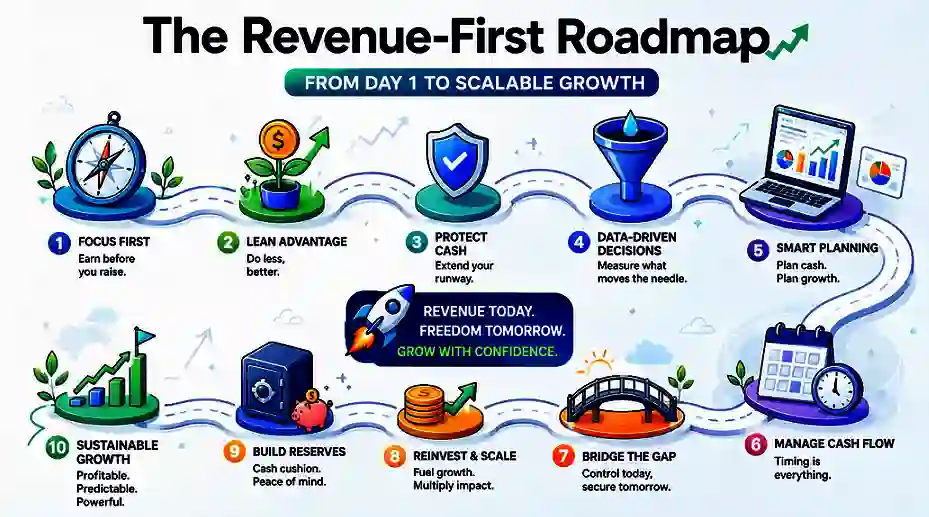
The roadmap to bootstrapped fundraising follows a stage-wise process to grow and attain success. Let’s have a look at it mentioned in table format below.
| Roadmap Stage | Brief description |
| 1. Plan Validation | Talk to customers. Confirm urgency & willingness to pay. Avoid “interesting” feedback. |
| 2. Sell Before Scale | Launching paid offers is vital (landing page, prototype). This test helps you verify whether people buy or not. |
| 3. Build Around Revenue | Study customers’ intent to know what they are actually paying for. Try to improvise based on their signal & intent. |
| 4. Protect Cash Flow | Revenue tracking, evaluating margins, customer Acquisition Cost (CAC), churn, & refunds. Keep a disciplinary attitude. |
| 5. Raise Smart | Raise your business with smarter choices, only with proof. Meanwhile, paying customers for retention is invaluable to achieve clear milestones. |
Common Mistakes to Avoid
Ignoring fundamentals.may jeopardise bootstrapped founders to make mistakes that retards their progress even with a strong strategy for growth. Let’s have a look at a myriad of common mistakes to avoid.
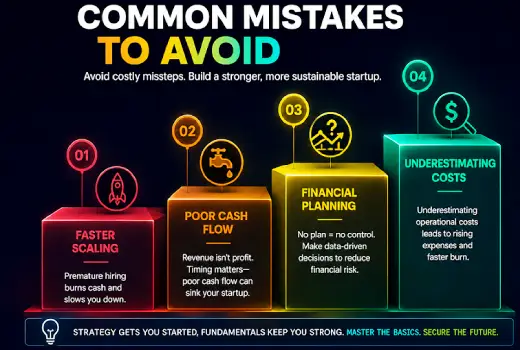
- Faster scaling without revenue: Premature hiring is not a novice decision; rather, you need to stop premature hiring to never face any drainage of your cash volume.
- Poor cash flow management: It is not always true that revenue gives you promising profit. It actually doesn’t. Timing is an important matter, and poor cash flow management can cause significant trouble to your startup.
- Not prioritising subtle financial planning: Not having any financial plan is not doing and taking data-driven decisions for a financial plan to deal with the ordeal and bring a reduction in risky financial consequences.
- Underestimating the real business cost: If you underestimate operational costs, you are vulnerable to rising expenses that depreciate faster and pose a threat to your startup.
Fundamental Advantages of the Booted Fundraising Strategy
The advantages of bootstrapping are multifaceted. They provide complete autonomy to take independent decisions without any intermittent pressure from the investor’s end, keeping their entire focus on customers and business necessity. Meanwhile, they never expect anything short term rather keep their long-term focus on business to make thoughtful and important decisions.
In terms of financial risk, bootstrapped startups are less vulnerable to financial backlash as they are not entirely dependent upon continuous funding to grow and consolidate. In terms of profit-earning potential, they experience growth by using internal resources without dependence on external capital sources. Booted founders require emotional resilience, unwavering patience and financial discipline to excel. Although growth seems a little bit slow, it promises higher stability.
Final thought
A startup booted fundraising strategy is an intentional growth of business led by better control and smarter decisions. Instead of external capital dependence, founders utilize their own revenue to fulfil customers’ intent, aiming to achieve long-term stability. Raising more funds is not the ultimate motivation; it focuses on better decision-making and quickly adapts to the market with better scalability, with no dependence on external investors.
Frequently asked questions (FAQs)
Startup Booted Fundraising Strategy is a way for raising business funds on the basis of early revenue from customers, personal savings, and lean activity of the business, with no dependence on angel investors or external funding.
SaaS products, B2B services and digital businesses are ideally matched with Startup Booted Fundraising Strategy. Here, early revenue generation is made without any heavy upfront initial investment from investors.
The biggest setbacks a business comes across may arise due to limited initial funding and slower scalability in contrast to funded startups, necessitating the demand for stronger discipline, resilience and commitment.
Hardware startups, heavy businesses relying on infrastructure, are demanding upfront capital; they need to avoid the startup bootstrapping fundraising strategy for their venture.