
Students run essays through ZeroGPT before submitting them. Teachers paste in work they’re unsure about. Employers check job applications. AI detectors are everywhere, so the question matters: can you trust the score?
In this guide I’ll explain how AI detectors work, what the research and the companies themselves say about accuracy, why honest human writing sometimes gets flagged, and what to do if it happens to you.
The short answer
AI detectors can spot some AI-written text, but they are not reliable enough to prove that someone used AI. They make mistakes in both directions: they miss AI text, and they wrongly flag human writing (a “false positive”). Even the companies behind them say a score should be a starting point for a conversation, not proof.
How AI detectors work
Most detectors look at statistical patterns in the text, especially:
- Perplexity: how predictable each next word is. AI models tend to choose very likely words, so their writing is often more predictable.
- Burstiness: how much sentence length and structure vary. Human writing tends to be more uneven.
The problem is that plenty of human writing is also predictable: short answers, formal reports, technical writing, and writing by people using a second language.
What the evidence says
OpenAI withdrew its own detector
In January 2023 OpenAI, the company behind ChatGPT, launched an AI text classifier. It withdrew it on 20 July 2023, citing its “low rate of accuracy”. In OpenAI’s own tests, it correctly identified only 26% of AI-written text and wrongly labelled 9% of human-written text as AI.
Detectors are biased against non-native English writers
A 2023 Stanford study published in the journal Patterns (Liang and colleagues) tested seven popular detectors on 91 TOEFL essays written by non-native English speakers. On average, the detectors wrongly flagged 61.3% of these human-written essays as AI-generated. The same detectors classified essays by US eighth-graders almost perfectly.
The researchers also found that asking ChatGPT to use “more literary language” made AI text far harder to detect. In other words, detectors can both falsely accuse honest writers and miss lightly edited AI text.
Turnitin’s own figures come with conditions
Turnitin says its AI detection has a less than 1% false positive rate at the document level, but only for documents where more than 20% of the text is detected as AI-written. These are the company’s own test results, not independent ones. Even 1% matters at scale: when Vanderbilt University disabled Turnitin’s AI detector in August 2023, it pointed out that a 1% rate would have meant around 750 of the 75,000 papers it submitted in 2022 being wrongly flagged.
What about ZeroGPT and GPTZero?
Free tools like ZeroGPT and GPTZero use similar statistical approaches and face the same limits. Independent tests published by researchers and educators have found inconsistent results across tools, with the same text often getting very different scores from different detectors. Treat any single score with caution.
Why your human writing might be flagged
You’re more likely to get a false positive if your writing is:
- very formal or formulaic, like a lab report or a five-paragraph essay
- short, because detectors have less to go on
- written in a second language, often with simpler, more predictable vocabulary
- heavily edited with grammar tools, which can smooth out natural variation
- on a common topic, where many texts use similar phrasing
What to do if you’re flagged
- Stay calm. A detector score isn’t proof, and many institutions say it shouldn’t be used as the only evidence.
- Show your process. Version history in Google Docs or Microsoft Word, notes, outlines and drafts are strong evidence that you wrote it.
- Offer to explain your work. Talking through your argument and sources shows understanding.
- Read your school’s or employer’s AI policy. Some allow AI for brainstorming or grammar if you say so.
- Ask what evidence is being used, and whether a human has reviewed the work.
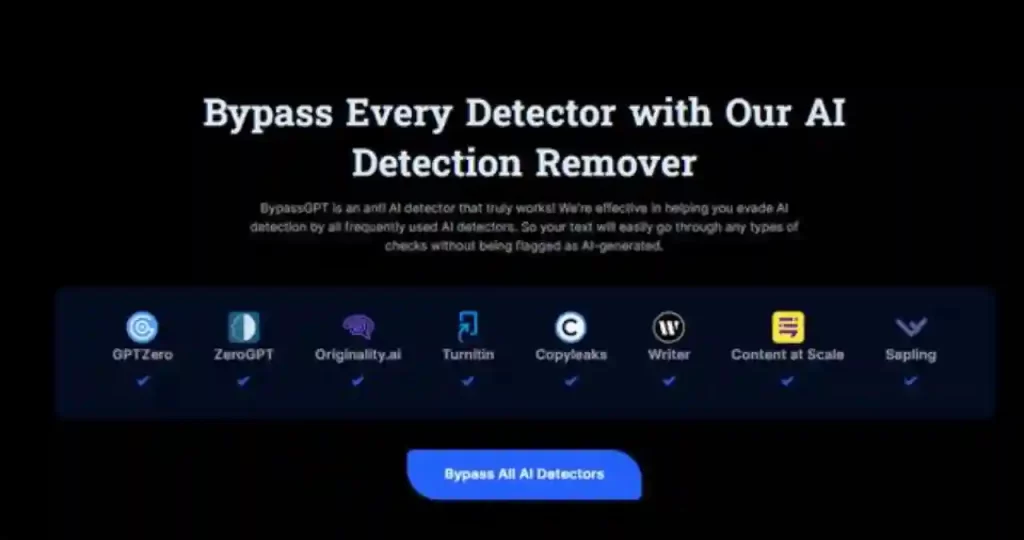
Rewriting tools that promise to “make AI text undetectable” aren’t the answer. I explain the risks in my BypassGPT review.
Advice for teachers and managers
- Use a detector score as one signal, never on its own.
- Talk to the person before drawing conclusions.
- Design tasks that show process: drafts, reflections, in-class writing and oral explanations.
- Be clear about what AI use is allowed, and ask people to declare it.
- Be especially careful with work by non-native English writers, given the research above.
Frequently asked questions
Is ZeroGPT accurate? It can flag some AI text, but like all detectors it can wrongly flag human writing. Don’t treat its score as proof.
What is the most accurate AI detector? There’s no detector accurate enough to prove AI use on its own. Results vary by tool, text length and writing style.
Can Turnitin detect ChatGPT? Turnitin can flag text that looks AI-generated, but the company itself says results should be interpreted carefully, and some universities have turned the feature off.
Why does my essay show as AI-written when I wrote it myself? Predictable, formal or second-language writing can look “AI-like” to a detector. Keep your drafts and version history so you can show your process.
Related guides on WebTechHelp
- How to use ChatGPT for school the right way
- How does ChatGPT generate responses?
- BypassGPT review: what it does and the risks
- ChatGPT vs Grok
Sources
- OpenAI: New AI classifier for indicating AI-written text (with July 2023 update)
- Times Higher Education: AI text detectors “biased against non-native English speakers” (July 2023)
- Vanderbilt University: Guidance on AI detection and why we’re disabling Turnitin’s AI detector
- CASRAI: AI detector accuracy: the false-positive evidence (August 2026)