
Do you notice the “People Also Search For” section on your SERP page while trying to find information for your queries? Are you somehow struck to find the relevant information you are looking for with your initial search query? At the first encounter, it may look like Google is suggesting something to you while you search for information on the SERP page.
Now, a question definitely pops into your mind: how does this help you with your site ranking & is it becoming a guiding star for making better content? Indeed, it is a powerful SERP feature that emerges as a suggestion to help users while they search for something and bounce back. Here in the blog i will give a mindmap to understand what it means, how it works, followed by the importance of it in SEO & much more.
What is the “People Also Search For” Section?
“People Also Search For” is a section in the search engine results page (SERP) that shows users with some relatable search queries in regard to user search intent. It is, meanwhile, a way to highlight information deemed relevant by Google to match the user’s original search.
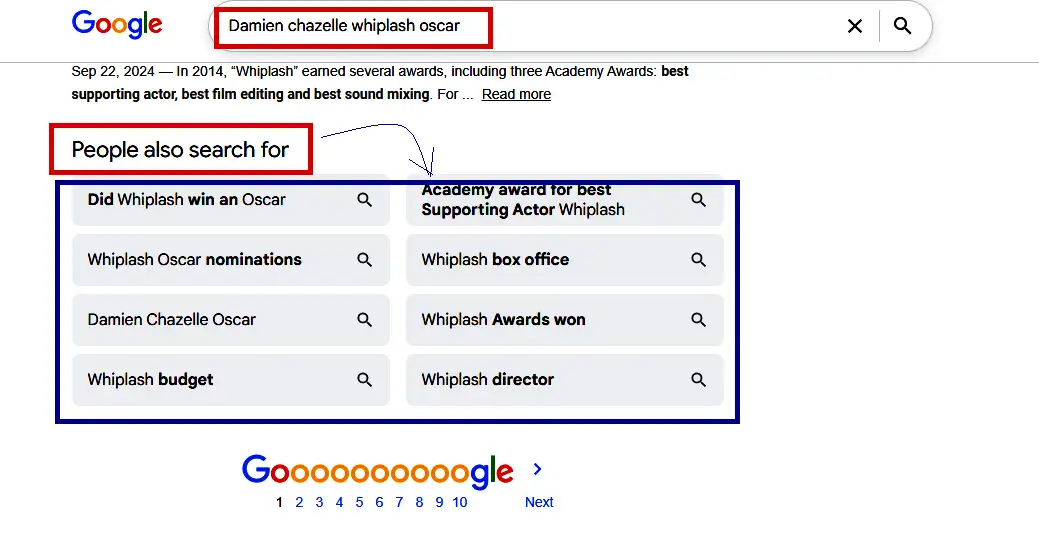
Let’s see an example to know how it appears after entering the search queries. Suppose you are searching for the youngest Oscar-winning Hollywood director, Damien Chazelle, whether he won any Oscars for Whiplash or not.
You just enter “Damien Chazelle Whiplash Oscar”. Now, after scrolling, you see the option that shows relevant info according to your search intent. Above all, the PASF feature assisted users in making the user-driven searching process more refined, easier, and seamless.
How Does It Work?
The generation of a query is entirely based on the searcher’s history data and the search pattern on a similar relevant topic online. Google uses its algorithm to gather a vast amount of search data to determine why users are not satisfied enough with search results.
If you search on Google, click on a link, and bounce back quickly to the SERP page then it acts as a signal. This is why it gives information as per user intent on the basis of the user query and past historical search data. Don’t confuse “People Also Search For” with “People also ask” (PAA) as SERP features on Google. To learn about the key differences between the duo, continue the blog and check the section just mentioned below.
The difference between “People also search for” and “People also ask”
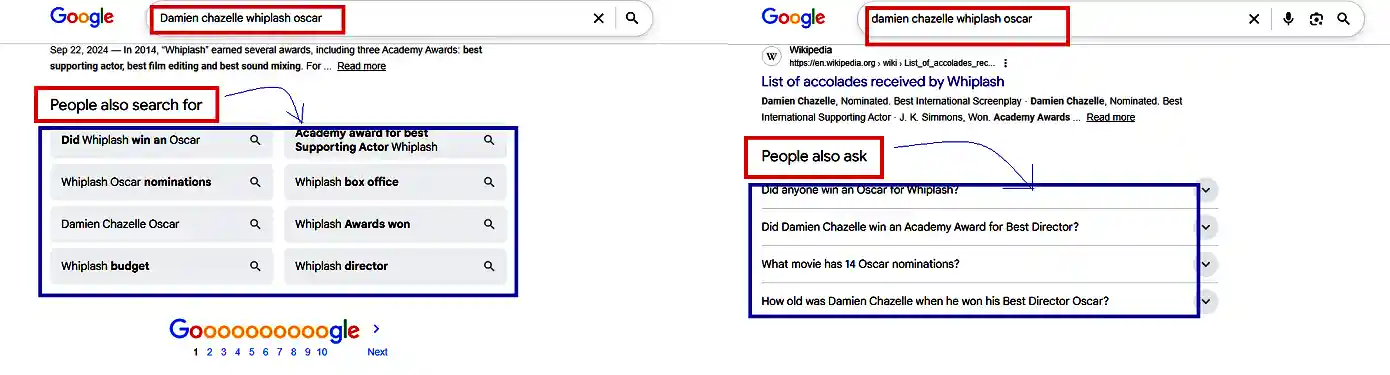
People often mess with “People also search for” and “People also ask” when you come across the duo on the SERP page. “People also search for” showcase a list of information having a similar tone, somehow deemed relevant by Google to support the search query intent. On the contrary, “People also ask” actually denotes a question listing in response to the main keyword that the person entered on the Google search tab.
Importance of PASF in SEO
You can find relatable queries from PASF to boost your overall SEO performance by making your content more optimized, helpful, and targeted. It is indeed an invaluable tool for SEO due to myriad reasons mentioned below.
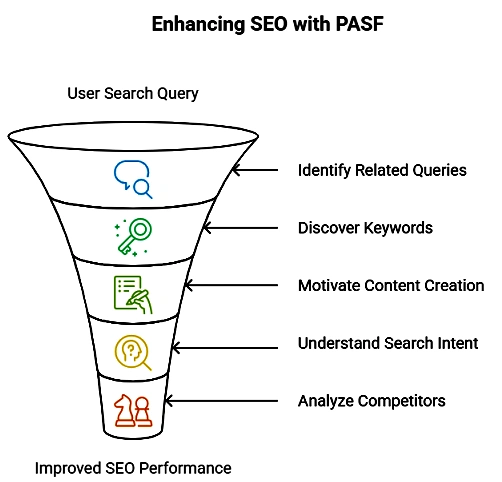
Here, I mention some reasons why it is worthy of boosting overall SEO or content optimization.
Google considers “Experience, Expertise, Authoritativeness, and Trustworthiness” (E-E-A-T) while ranking content. Making a reader’s satisfactory content helps an article rank on SERP. Here’s how the PASF box would become the game changer.
Meanwhile, it opens the backdrop to identify additional information that doesn’t come to the user’s notice beforehand. The queries are serving as a guiding light to motivate users to make optimized content.
Above all, it is capable of making out the true intent behind every search, whether it may be transactional, informational, or navigational. Comprehending this helps users to understand what exactly the competitors target. Above all, it acts as a solution to keep them well-informed on how to fill the identified gap.
How PASF Can Alter or Extend Behaviour for User Search
The feature of PASF influences the overall user behavior in multiple ways, as mentioned below
- Diversify the search: The PASF feature presents users with a relatable topic on the basis of the user query, which they initially lack behind with no information-based consideration about it beforehand. This diversifies the search dimension and equips them with fresh ideas. It is also helping to enrich them with a broader perspective on the search query.
- Improving precision: This feature suggest relatable search option to the user, which somehow assists them to make a refinement of their search query. It even helps them to transform their vague query into a meaningful one. It is somehow driving content with more precision and improved relevance.
- Feature to aid information retrieval: For users who find it really intimidating to frame a proper search query, the feature that people also search for is a boon for them to suggest alternative phrasing to make information retrieval easier.
- Discovering information: This feature gives users some remarkable ideas of the query that initially dont strike their mind. This feature somehow acts as a suggestive mentor to discover novice information for their search query.
Why Google Displays These Related Queries
Google is aiming to provide users with the most relevant and helpful results as per their search query. Indeed, it assists users in simplifying the search complexity. Additionally, it is helping users to explore distinct facts and alternate angles of their search queries. It also helps to rediscover newer insights and additional information that initially fall behind during the search.
Tools to find people also search for keywords
Here, I mention some worthy tools that assist you in finding “people also search for” keywords.
Google’s SERP: To find PASF keywords, open your browser in incognito mode by simply pressing the keyboard shortcut (Ctrl+C+N). Now type your keyword and click the back button to watch the opened pop-up for it. You can also Google the keyword on your browser and scroll to the bottom to rediscover the keyword ideas.
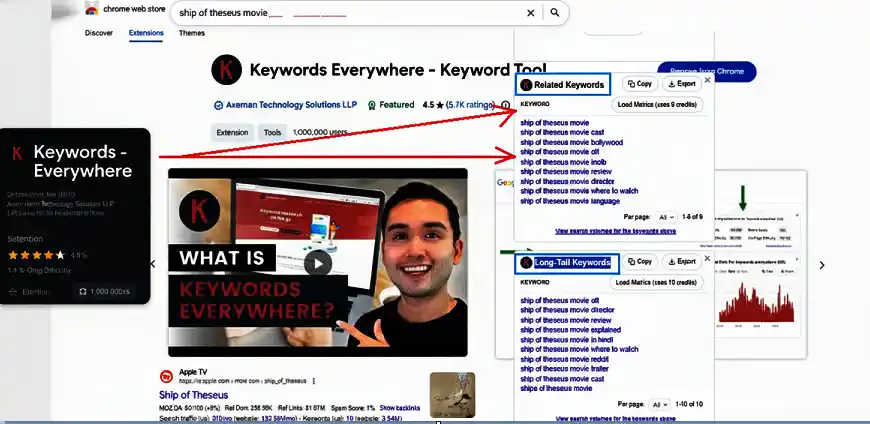
Keywords Everywhere: There is also a Chrome extension, namely Keywords Everywhere, that helps you to go through some extra SERP features for your entered keyword. If you install the Browser extension, you can see something like as seen in the image below. Suppose I want to enquire about the “Ship of Theseus” movie released in 2012. The “Keywords Everywhere” tool shows me information for Related Keywords and Long-Tail Keywords.
How the People Also Search For Is Priceless to Optimize Content
After the gathering of data from PASF, you need to put in extra effort to drive organic traffic build-up and boost the overall ranking.
Strategically Incorporate Keywords: After the blog review has been carried out, all you need to do is just incorporate the keyword naturally within the blog in
✔️ Headlines
✔️ Body text
✔️ Subheadings
✔️ Image alt text
✔️ Meta descriptions
PASF queries included some long-tail keywords having lower competition but higher intent. The content optimization helps users to gain a better rank among SERP results and propel the niche audience. Collectively, this helps your content to attain better content visibility.
Ideas for Content Creation: The People Also Search For opens a horizon to dish out user with some novice content ideas. Let’s have a look at the example with the image snippet below.
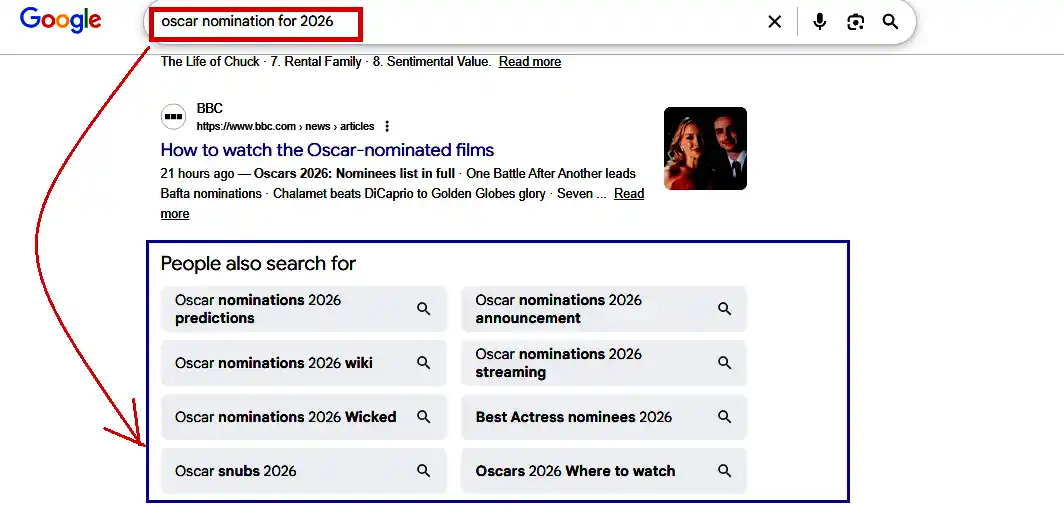
Suppose you search “Oscar nomination for 2026” on Google. This search query can bring 8 new ideas to make a plan for a better framing of the topic cluster. These query helps you to make out painpoint of the user or the information that needs to be addressed. Based on this suggestion, you can add this information of FAQ to never miss out on making optimized content.
Final thought
People also search for is an essential instrument act as a boon to modern-day SEO strategy. It not only acts as a tool to bring improvement for searchvisibility but also keeps prioritization on content quality. No one denies the daunting challenges to rank on top in SERP results.
Above all, if you can make out the true user intent and make content optimized to satisfy the user’s need, then it is inevitable that it will boost your site traffic and skyrocket your growth on Google in terms of SEO strategy.