The platform event trap is an unintended inefficiency of the system that influences Salesforce to handle real-time data. Do you know that several IT administrators found it arduous to get out of the trouble while immersing themselves in a platform event trap?
Sound interesting and make you curious to know more about it? In the blog, I will give a complete walkthrough for it, what it actually is, key areas, and also the approach necessary to avoid this. So let’s roll.
What is a Platform Event Trap?
A platform event trap is an unintended happening of sudden system inefficiencies that stem from poorly framed and misused event-driven overhaul. Meanwhile, in an era of software and technological upbringing, the term platform event trap has gained increasing traction, becoming a buzzword among people.
How Does a Platform Event Trap Happen?
Platform events are a boon for Salesforce organizations, seemingly help then to handle events based architectural model on the basis of data-driven insight. Despite its credibility in handling platform events, there are still cause IT administrators face some trouble with its subtle implementation stemming from the platform event trap. It resonates not only with a single cause that led to system outrage or data loss, but also with multiple mistakes that render intermittent issues.
Multiple factors trigger the happening for platform event trap.
- Ignoring appropriate safeguards to handle the system can lead to overconsumption of system resources.
- Relying on the system too much can lead to unnecessary system-based architectural complexity.
- Overlook the security setup.
- Sometimes, the poor design can cause a data duplication glitch if similar events are reprocessed multiple times.
The Anatomy of Platform Event Trap
Some predictable patterns are obvious with a particular event. Let’s examine the entire anatomy of the platform event trap from scratch.
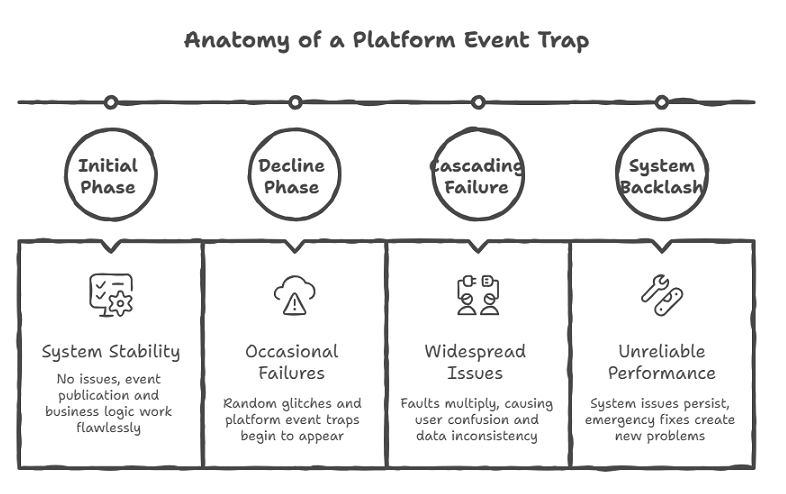
✔️Initial phase: There has no initial system hiccup stemming from the testing and development phase. In this phase, there are no issues with anything, as everything works fine as intended. The event publication by flow is obvious. The subscribers also gain accessibility, and the execution of business logic is flawlessly executed.
✔️Decline phase: With a rise in data, some occasional failures are starting to reveal themselves. These are random glitch often appear as a platform event trap.
✔️ Cascading failure: When the issues of fault are compoundly multiplicated then, it renders user confusion with data inconsistency. Hence, it makes tracking for the identification of the root cause extremely difficult.
✔️System backlash: Some system issues are indeed present, causing the systems to not perform the work reliably. Emergency fixes can give rise to intermittent issues or some new problems that erode the dependency on the event platform.
Key Areas Where Platform Event Trap Gains Grounds
It is an undeniable fact that having a key understanding of the platform event trap significantly influences system integration, event-based propagation, and data synchronization in real time.
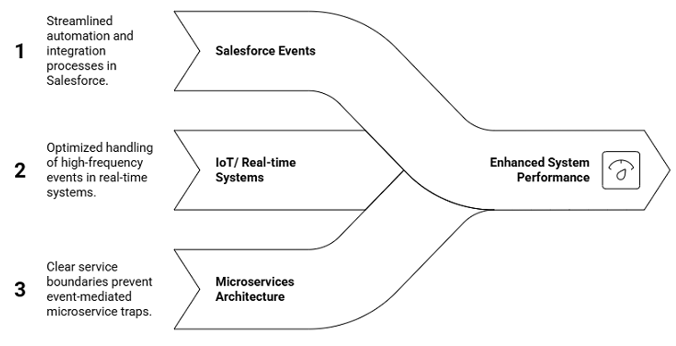
Salesforce events: Process automation and system integration are important tasks that require the role of developers. Meanwhile, it is often found that the feedback within the system is somehow overtriggered, that lead to the generation of an unintended feedback loop.
IoT/ Real-time system: Sometimes, High-frequency events cause serious system bottlenecks that render the system crashing, arising due to deduplication or improper throttling.
Microservices-based Architecture: Sometimes event-mediated microservices get into traps due to instances of not properly defined service boundaries. It is also somehow happiness, while one output of services without intent becomes the input of another without proper control.
How to Avoid the Platform Event Trap
If you are someone who truly wants to avoid falling into the trap of a platform event, reconsider the best practices mentioned below to avoid any unresolved issues.
- Do check the backward compatibility and become vigilant enough to avoid any unintended issues of dependency.
- Clarity in defining the event ownership carries significant roles in avoiding the platform event trap.
- Keeping periodic monitoring of the track event volume and deliberate usage of system resources helps to prevent the system from falling into any unmanageable architectural pitfalls.
Wrapping up
In a nutshell, it is beyond description that platform events are incredibly powerful. The main cause that matters most is the usage pattern to determine whether they are correct or not. Having a key insight into the true cause behind platform event trap are invaluable as it helps deliver a scalable and resilient sales force-based system integration.
Frequently asked questions (FAQs)
Ans: Yes, definitely, the platform event can have the capability of handling large-scale integration flawlessly and efficiently.
Ans: Platform event traps are some common, unignorable problems that may cause Salesforce to experience unexpected issues in production. The root cause behind the problem stems from synchronous processes issues, overlooking limits, and also ignoring delivery on guaranteed manner.