Critical thinking exercises are invaluable for every individual, not limited only to their academic competence. Working on the exercise is like a process that enables an individual to visualize things from a distinct perspective, identify potential biases, and also aid in finding possible solutions to any problems.
Work on sharpening the critical thinking skills is indeed needed to have a positive mindset. Here in the blog, I discuss 5 critical thinking exercises to improve your critical thinking skills.
Why We Need to Practice Critical Thinking
We are not born as critical thinkers. It takes time and effort to gain mastery over critical thinking. So practice consistently, and a passion for developing over time is invaluable for rising to the growth ladder. Exercising critical thinking helps an individual to analyse various information and make well-reasoned or rational decisions based on situational applicability, both for personal and professional pursuits.
This practice of critical thinking experience helps individuals to deal with misinformation by promptly identifying it and nurturing the skills for a deeper understanding of complex issues. So practicing critical thinking exercises not only allows us to solve problems but also paves the foundation for coming up with innovative ideas like never before.
5 Critical Thinking Exercises To Develop Your Critical Thinking Skills
💡 Exercise 1: The Ladder of Inference (Seven rungs)
You can improve your critical thinking skills by taking lessons from the Ladder of Inference model. Designed by renowned psychologist Chris Argyris, this model is instrumental in helping to transform observed data into actionable insight.
This model enables you to look at data and facts in an unbiased manner. Meanwhile, it also assists you to make an inference and dont hurry to conclude too soon. Before proceeding further, let’s make out how this model actually works. This model breaks down the ladder into seven rungs, as seen below
How it works
You might climb up the rungs of the ladder by navigating the steps as mentioned below
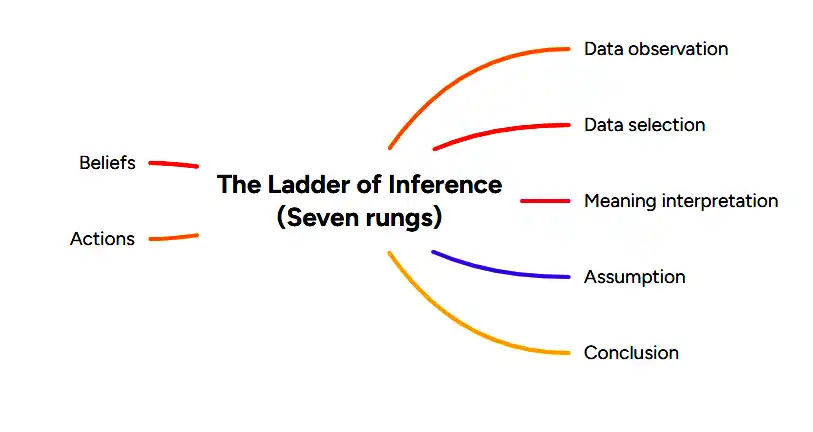
- Data observation: It helps you see what actually happened
- Data selection: what you want to notice
- Meaning interpretation: The meaning we put forward based on the situational circumstances
- Assumption: Based on interpretation, what we actually believe
- Concluding: The conclusion we come to at the end
- Beliefs: What we actually believe
- Actions: The actionable steps we take
Example
Suppose your boss at work tells you to “We need to rethink the project with the timeline.” Data observation here is what the boss says to you by mentioning about rethinking your project timeline. You only notice the tone he used, not taking “we”(team efforts) into consideration. So you think something went wrong on your end without further consideration.
You may think you’ve messed up the project timeline. So you jump to the conclusion that you are wrong.
You believe the boss was not satisfied and took action by entirely changing the project timeline in an overly apologetic manner, although it required only a minor tweak for rectification. Meanwhile, to stop the ladder, you need to think back by analyzing what he actually means and also all possible situations. So it will help you not to make a hasty conclusion too soon.
💡 Exercise 2: Inversion
Inversion is another critical thinking exercises that helps an individual to think about a negative perspective on something rather than being stuck in positive circumstances. Let me make it simple for you. Instead of thinking “ how could I become successful, ” question yourself about “what if I could have failed.” Now work on it by working, which will help you to emancipate from those failures that may strike at your door.
Example to make out how inversion works
Suppose you are going to start a business venture. Instead of asking yourself how to succeed, question yourself what if you don’t achieve what you actually yearning for? This might include the probable concerns stemming from context, like
You end your venture in bankruptcy
The business might face financial backlash
You might not engage yourself properly with the tasks
By thinking about all the possible adverse contexts now, you try to figure out how to get rid of these risks by working on your critical thinking. So it will help you to make yourself better prepared for any such adverse identified situation before it happens in the future.
💡 Exercise 3: The Five Whys
Example to make out how “Five Whys” works
Suppose you are a business owner, observing that your customers’ satisfaction is starting to decline. Ask yourself “why” until you reach the actual cause behind such a happening.
Issue: Customer satisfaction is starting to decline.
- Why? Customers have now started to feel differently.
- Why? Does a slow response take longer than usual to resolve customers’ tickets?
- Why? The customer’s support is not as satisfactory as it initially was.
- Why? We lack the staff strength to reach the current bulk customer volume.
- Why? We don’t onboard staff, although the customer base is on the rise.
Grassroots reason: inadequacy of staff onboarding despite business expansions.
Now you see the grassroots reason by taking help from five whys that clearly shows the actual cause is not limited to individual performance, but also for inadequate allocation of sufficient resources.
💡 Exercise 4: Argument Mapping
Have you ever felt that ideas got scattered, necessitating the need to sketch them out appropriately? It is a mind map that helps you to retain information better than ever before. Similarly, the mindmap, argument mapping help to visually represent ideas more specifically the structure of the argument. It also assists in evaluating ideas and making new ones wherever or whenever necessary.
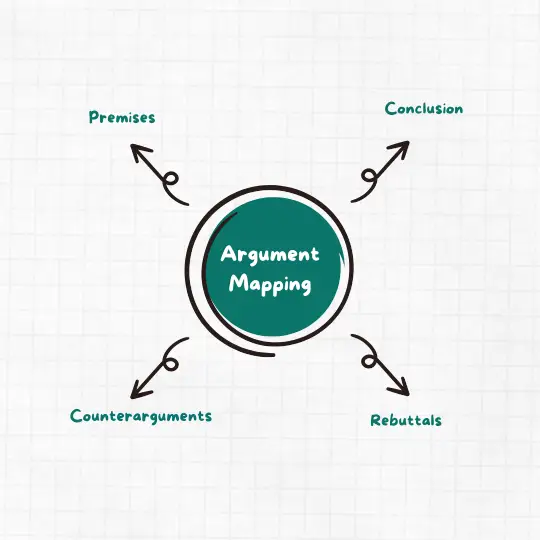
So, if you are eager to find logical relations that exist between the components of an argument, I must say Argument Mapping helps you to give clarity and keep thoughts more organized.
Kudos to Toyota founder Sakichi Toyoda for making a technique, “Five Whys.” This technique helps an individual to dig out the root cause behind any encountered problem. Meanwhile, it is also another critical thinking exercises that seems beneficial for improving critical thinking skills. Let’s make me explain.
Example to understand Argument Mapping
Imagine yourself being a businessman, suppose you plan to introduce remote work at your workplace. There are some components of arguments that may arise with it. Let’s check it out.
| Components of arguments | What is it actually about | Examples |
| Conclusion | principal claim | We must introduce remote work from next month, no matter what. |
| Premises | Supporting reasons | 1. Bring a reduction in overhead costs at the workplace 2. Guarantee employee retention 3. Ensure more inclusion of adept talent |
| Counterarguments | Opposing views | 1. Render communication hurdles 2. May cause security concerns with remote accessibility |
| Rebuttals | Response that stands against Counterarguments | 1. Setting up a VPN helps to reduce security threats 2. Leveraging some modern tools helps to bridge the gap in communication. |
💡 Exercise 5: The Six Thinking Hats
Pay homage to Edward de Bono for developing the Six Thinking Hats model. It welcomes the sharing of a diverse perspective on a single issue without limiting to any single perspective. It is a teamwork tool, while teams are segregated into six groups represented by distinct colors of hats. Let’s have a look at it.
✔️ White hat: Neutral, having a focus on facts.
✔️ Black hat: Cautious, looking into the adverse outcome
✔️ Red hat: Intuitive, feelings, emotions are given prior focus
✔️ Green hat: Creativity-driven decisions, share innovative ideas, little focus on criticism.
✔️ Yellow hat: Optimistic, shares positive aspects
✔️ Blue hat: Controlling entire management activity
Members of each team represented by different hats, as mentioned above, to examine an instance from a distinct perspective. Meanwhile, it prevents a single viewpoint from dominating in meetings and gives a holistic outcome stemming from different angles of opinion.
Example to make out Six Thinking Hats
Let’s picture a situation by yourself. Suppose a situation arises in a firm to decide on remote work inclusion. Now the question arises, “Is it feasible to adopt fully remote work?” Let’s have a look at how distinct team members for each group (wearing distinct colored hats for 6 groups) share distinct angles on the common issue.
| Opinion of each teammate wearing different hats on “Is it feasible to adopt fully remote work?” | ||
| ✔ White hat | Neutral | 👉65% of employees demand remote work 👉Turnover decreased by 15% by embracing remote work |
| ✔ Black hat | Cautious | 👉Team collaboration may be hampered by WFH👉It becomes tedious to train newly onboarded employees or junior staff |
| ✔ Red Hat | IntuitiveFeelings driven | 👉I am concerned with the mental health of everyone👉I think team spirit faces trouble and suffers a lot |
| ✔Green hat | Creativity | 👉Arrange a virtual team meetup weekly 👉Introduce a novel tool to make remote culture just like fun |
| ✔ Yellow hat | Optimistic | 👉Work-life balance leads to better employee retention👉More productivity gain while embracing remote work |
| ✔ Blue hat | Controlling the entire management activity | 👉Address the top 3 concerns on priority and make a prototype to plan for a hybrid workspace |
Wrapping up
In a nutshell, it is noteworthy that everyone needs to train their brain regularly with critical thinking exercises. It is like a workout exercise that helps to build muscles. Although it takes time to develop, it still requires working on regularity to make it a mandated habit.
If you truly want to strengthen your critical thinking skills, follow the 5 never-missed-out hacks to laser-sharpen them, as I mentioned in the blog. If you have anything to know more about, feel free to comment below so that I can reach you.