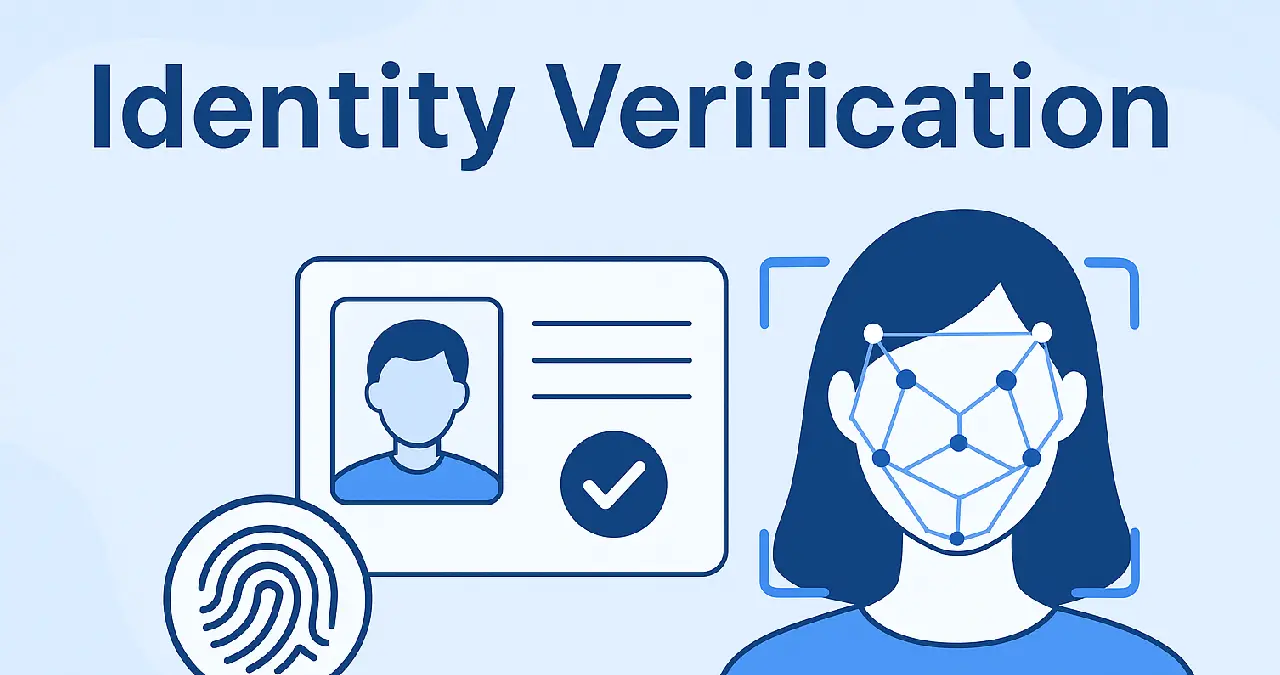
With businesses going digital with their services, identity verification has become a fundamental principle of digital trust. It may be the opening of a bank account, applying to obtain a loan, or registering on a fintech platform; nowadays it is necessary to verify who a person is. Increased regulatory pressure regarding KYC (Know Your Customer) and AML (Anti-Money Laundering) compliance and the emergence of synthetic identity fraud makes identity verification not only an industry best practice but also a requirement.
What Is Identity Verification?
The identity verification means the verification of the identity of a person based on information stored about them. This would have, in the olden times, required a manual check of a passport or ID card. Now, it is a very high-tech digital procedure that involves biometric verification, document verification based on AI, and real-time database validation.
The methods are currently employed by businesses to minimize fraud, improve customer onboarding, and promote regulatory compliance. Identity verification can be used in banks and crypto exchanges, as well as in healthcare and e-commerce websites, to provide secure and seamless compliance.
The History of Identity Authentication
Identity authentication in the modern context is much broader than passwords and PINs. It is all about the overlay of several technologies to ensure the authenticity of the user on all points of contact.
Today’s solutions combine:
- Id photo match with selfie facial recognition.
- Biometrics of fingerprints or voice, unique human verification.
- Analytics of behavior to monitor user trends and signal abnormal behavior.
These methods make sure that identity verification is not limited to the onboarding process, but instead it persists throughout the user lifecycle. Multi-factor identity authentication has been used as a control measure against fraud and the protection of customers as digital ecosystems grow.
The Synthetic Identity Fraud and the Broken Spears
Synthetic identity fraud is the most difficult and harmful of all forms of digital fraud. In comparison with identity theft, when a fraudster steals the identity of an actual person, synthetic fraud is a combination of both true and false information to establish a new plausible identity. To illustrate, a fraudster may present a valid number of Social Security (along with an invalid name and address).
This kind of fraud is especially difficult to trace as the identity is not that of a living person, and therefore victims are unaware of the fact that they have been compromised. Faked identities are able to go through simple verification processes and even credit histories with time, consuming financial institutions billions of dollars in the process.
Identity verification applications that operate on AI can assist in identifying these trends by comparing a variety of data sources and tracking inconsistencies that the conventional models would not notice.
The Reason why Identity Verification is Important in Businesses
Strong identity checks are no longer necessary only to banks. Any online platform such as e-commerce websites and online games and health portals are vulnerable to fraud, information theft, and fines.
Here’s why it’s essential:
- Adherence to international standards: KYC, AML, and GDPR regulations need identity verification, which stops financial offenses.
- Customer loyalty and retention: Consumers will prefer using platforms that offer security to their data and provide them with a high level of security.
- Fraud prevention: Intense identity checks reduce chargebacks, account hijackings, and phishing.
- Scalability: The automation of the verification process allows onboarding in a more expeditious way, without affecting the quality of the results.
Future Technologies in Identity Verification
The introduction of advanced tools has enabled the verification of an individual digital identity to be efficient and easy. The technologies that are at the forefront include:
- AI/Machine Learning- Applied to deal with document authenticity, deepfakes, and anomalies in real-time.
- Blockchain -Facilitates identity storage that cannot be tampered with, increasing privacy and security.
- Biometric Systems Fingerprints, iris scan, and facial mapping are now common practices in most industries.
- Liveness Detection – It eliminates spoofing when verifying a selfie or video.
These technologies simplify the process and make it safer and scalable between a variety of jurisdictions.
KYC Compliance and Identity Check
The world regulators are getting tough regarding the way businesses garner and confirm the identities of the users. Inability to introduce powerful verification mechanisms may lead to fines, information leakage, or business licenses.
KYC and AML systems require companies to conduct thorough verification of a customer to determine their authenticity. This has been made easier with automated identity verification systems that ensure compliance without having to work manually by verifying information in real-time.
Indicatively, the U.S. financial institutions are required to comply with the Patriot Act, and the European business is bound with eIDAS and GDPR regulations. The nature of the requirement is still the same: check, track, and control.
Identity Checking in Real Life
In addition to compliance, identity checks promote convenience and security in daily interactions.
- Digital onboarding of Fintech involves instant ID checks.
- Patients are verified before they are allowed to access medical records, by healthcare organizations.
- Verification systems are established to ensure that fraudulent orders are avoided by the E-commerce companies.
- Biometric authentication is also applied in the travel and immigration industries to speed up the control of the borders.
The uses are infinite, as do the ways of verifying online gaming ages or defending mobile wallets.
The Future: Identity Decentralization and Control
The second stage of identity verification is decentralization. The personal information of users can be managed by the users themselves using decentralized identifiers (DID) without having to distribute it every time among several platforms. Identity frameworks based on blockchain enable such a process to occur safely and privately and minimize the threat of data breaches.
With the increasing cases of privacy and the sophistication of synthetic identity fraud, decentralized verification may be the international standard where users verify themselves with complete ownership of data.
Conclusion
The world is shifting to a completely digitalized future, and identity verification is the cornerstone of the future. No longer a back-office compliance activity it is a trust-building, risk-reducing and customer-focused process that characterizes the work of contemporary organizations.
As the risk of identity fraud via synthetic means is increasing, a company that implements state-of-the-art identity authentication and verification devices will not only avoid the crime but will also be able to develop a competitive edge based on trust, transparency, and innovation.