
Are you truly reimagining a virtual video conference room that connects people from any distant parts of every nook and corner of the globe? Now it’s time to welcome the multipoint control unit that works as the core functional element of the video conferencing ecosystem. It is a gateway that expedites scalable communication in video conferencing.
So if you are willing to connect multiple people in real-time interaction, then it’s time to bid adieu to two faced video calling, as the virtual world is constantly renovating and redefining the video conferencing ecosystem through this video transcoder called multipoint control unit. Here in the blog I will give a complete overview of how the MCU works, its advantages & disadvantages, and much more.
What is an MCU (Multipoint Control Unit)?
The need for video conferencing to connect multiple people simultaneously in real time is becoming a burgeoning reality. The breakthrough of the multipoint control unit breaks the barrier of earlier meetings that were limited to only two people. The good news? The video conferencing system activity led by the MCU connects a number of users with a single network while performing a wide range of functions at the same time.
This video transcoder transforms ordinary video communication into an efficient business deal. Here, multiple people join the same video chat from remote locations in every nook and corner. Sounds amazing, doesn’t it? In a nutshell, MCUs are the backbone for video conferencing to bring spread-out teams across the globe into proximity.
How does the MCU work – The Technical Foundation
The technical foundation behind the working mechanism of the transcoding server is straightforward. It works by collecting the video and audio feed from participants who are actively involved in the video conferencing process. The video communication from distinct sources is well synchronized, so that each participant hear and sees what is actually happening at the video conference.
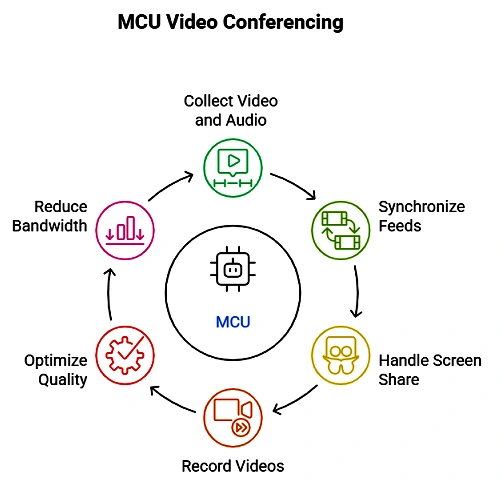
The MCU also comes up with extra features that make it capable of handling screen share and recording videos. Leveraging an algorithm helps MCUs to make an optimization for audio-video quality and lessen the bandwidth consumption for the same.
Types of MCUs
There are distinct types of multipoint control units while each functions as per the specific context. Picking the MCUs you want is solely dependent upon several factors, including the number of people participating, the budget, and last but not least features you need. Let’s explore the common types of MCUs available.
☑️Hardware MCU
Hardware MCU is a physical piece of equipment perfectly suited for a mega organization having lots of people participating in video conferencing. Despite having upfront costs and regular maintenance, it is still a credible physical device handling people with better performance.
☑️Bridge MCU
Bridge MCU is helping different systems that run multiple videos altogether, even if they are dependent upon varied protocols or technologies of interest. In terms of hassle-free and smooth collaboration, these special units are worthy, no matter which tools are leveraged by the user or not.
☑️Software MCU
Software MCU is the virtual form of Hardware MCU that works entirely on server based platforms. Unlike a hardware MCU, which has higher upfront costs, the cheap & scalable version of a software MCU makes it well-suited for small firms, especially for businesses necessitating last-minute virtual meetings.
☑️Hybrid MCU
A hybrid MCU brings about a perfect amalgamation between software and hardware. The well-deserved synchronization seen in the hybrid MCU makes it appropriate to use for communication needs. The scalable unit keeps a perfect balance between costing & power usage.
How do MCUs perform in video conferencing
MCUs play an important role in managing the video conference ecosystem. Meanwhile, it acts as a coordinator that keeps a close eye on data streaming and connection management during a video call. A noteworthy task that is handled by a multipoint control unit is the capability to link multiple screens for video calls from distinct spots.
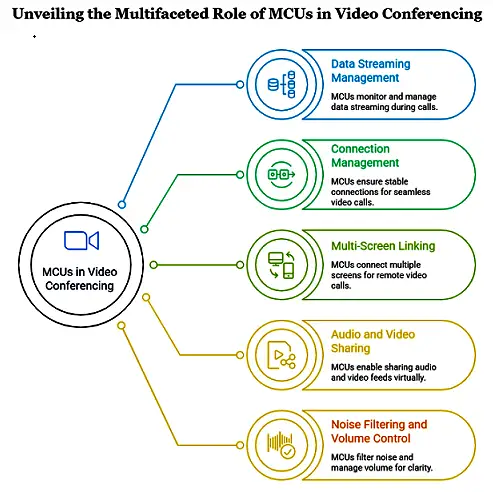
Here audio and video feed of an individual becomes sharable under a virtual video setup. This is somehow helping people connect remotely from a distant part, where they each listen and see the virtual-calling setup without any hiccups. MCUs ensure smooth video streaming by filtering unnecessary background noise and managing the sound volume with clarity.
Pros and cons of the Multipoint Control Unit architecture
As of now, you have enough understanding about what the MCU actually is, the technical foundation behind how it works, types of MCUs, and how it performs in video conferencing. Now let’s check some pros and cons. See the tabular data that exemplifies the pros & cons of the Multipoint Control Unit (MCU).
| Pros of MCU | Cons of MCU |
| Single combined video stream → lower client bandwidth & decoding load | Fixed layout → no user control |
| Much simpler front-end (subscribe to one stream only) | Decoding + mixing + encoding all streams → expensive scaling |
| Unified & consistent layout (server-controlled) | Slightly higher latency from mixing & errors affects everyone |
Wrapping up
The Multipoint Control Unit is becoming the powerhouse of scalable communication that assists businesses with video conferencing. The MCU narrows down the gap between locations and is able to stream audio and videos seamlessly in a smooth, sleek, and reliable manner. This is capable of transforming a basic video call into a powerful tool for business, through its scalable and cost-efficient architecture.