
In this online arena, only growth strategies are no longer effective in modern business. Today, it is all about digital transformation through adaptive technology and automation.
As businesses are under immense pressure to meet rising customer demands and adapt to new technologies, agile solutions promise to support sustainable change. It manages the complexities of digital change through meaningful progress.
If you are also in search of solutions that will help you scale business transformation, you have arrived at the right place at the right time. We are going to share the top 7 approaches and practices for digital transformation with scaled agile solutions.
So, let’s get started by understanding what digital transformation is and what agile solutions are in it.
What Is Digital Transformation?
Digital transformation refers to the integration of digital technology into all business areas to transform existing processes, customer experiences, and culture, meeting the evolving needs of the digital marketplace.
That’s a long sentence! Yes, this process is essential for every business today to stay competitive through advanced technologies like AI, big data, and cloud computing.
But digital transformation for larger organizations with complex project plans and multiple team coordination is difficult. Right? Not really with scaled agile solutions.
What Is Agile Solutions’ Role in Digital Transformation
Agile is a methodology that offers an interactive and flexible framework to break down huge digital transformation projects into smaller and faster tasks. This solution helps organizations with rapid adaptation to changing environments while making the process less risky.
Instead of immediate, big bang shifts, scaled agile digital transformation focuses on cross-functional collaboration. Here’s a clear roadmap of the process that will help you understand how the agile solution helps with successful digital transformation for large-scale businesses:
Scaled Agile Roadmap
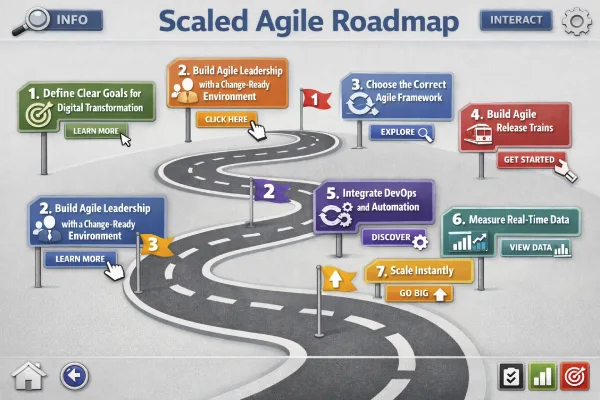
- Defining Clear Goals for Digital Transformation
- Building Agile Leadership with a Change-Ready Environment
- Choosing the Correct Agile Framework
- Creating Agile Release Trains
- Integrating DevOps and Automation
- Measuring Real-Time Data
- Scaling Instantly
7 Best Practices for Digital Transformation with Scaled Agile Solutions
When you are planning for digital transformation, adopting scalable agile solutions is the key. Here are the top 7 agile frameworks and approaches that will help you with faster movement:
Scaled Agile Framework (SAFe)
For large businesses with multiple teams working on the same and different projects, digital transformation may sound challenging. Using the Scaled Agile Framework (SAFe) means a structured solution for enterprise-level businesses to adapt to a changing environment faster with improved quality.
This framework helps with digital transformation by aligning strategy to successful execution. Businesses of any size and complexity can scale by responding better to this digital change.
Scrum@Scale Frameworks
This framework is another comprehensive solution for scaling agile solutions. Organizations with multiple team coordination operations can use this interconnected cycle of Scrum Master & Product Owner to drive digital transformation faster.
While the Scrum Master cycle focuses on smaller team processes, improved workflow, and ensured execution, the Product Owner cycle aligns the product strategy, cross-team dependency, and backlog prioritization. That’s why it is a standard process to use scaled agile solutions for digital transformation.
Integration of Agile Platforms
The integration of agile platforms like Jira Align, Azure DevOps, and others helps with better digital project management. They allow smoother adoption of AI and Cloud for a more satisfactory customer experience.
These tools not only offer real-time progress, bottlenecks, and dependencies but also support your teams in responding quickly to the changing digital market conditions. So, this integration provides an essential technical foundation so that you can execute your digital transformation strategy effectively and efficiently.
Using Pilot Programs
Digital transformation poses high risks like operational disruptions, data breaches, cost overruns, and even vendor lock-in. That’s why pilot programs are crucial.
They provide a more controlled way to try & test new tech and identify any integration issues. By avoiding large upfront investments, these programs allocate agile solutions strategically so that your teams enjoy small wins.
Strategic Alignment with PI
Practicing strategic alignment of agile solutions is essential for digital transformation victory. You need to ensure that the business goals, transformation process, teams, and agile leadership match. But how?
Your business or organization needs the Program Increment (PI) planning so that all teams have the same objectives and priorities, and can map out work for the next increment. PI ensures your digital transformation delivers high-value returns by successfully scaling agile methodology.
Customer Centric Approach
Rather than investing in any of the trending technologies, businesses or organizations should focus on customer centricity. This approach helps you to see things from the customer’s viewpoint and come up with a digital solution that immediately attracts customers’ attention.
By considering the entire customer journey, you can make the digital transformation interactive and ultimately successful.
Continuous Feedback Loops
Even scaled agile solutions are inherently challenging. While transforming your business digitally, regular feedback loops help to find any roadblocks. It ensures that the new technology implementation is meeting all the customer’s demands and your business objectives.
Can Digital Transformation Still Fail?
According to a report by West Monroe, around 47% of organizational executives have revealed that even less than half of their employees embrace digital transformation. Additionally, 30% of them noted mindset gaps within the work environment.
So, yes! There are chances of massive digital transformation failures even when you follow scaled agile solutions. Reasons? Here they are:
- Middle management and employees often fear losing their authority due to the shift from traditional command and control to agile culture.
- Many organizations and businesses began without a clear goal and invested in technologies that are not meant for the specific industry.
- Considering scaled agile solutions as a mere checklist, but not as a strategic process for digital transformation.
- A lack of knowledge and less experience with scaled agile methodologies frequently lead to failure among teams.
- Many organizations and businesses think that digital transformation is an overnight process, but in reality, it takes years to reach maturity with an agile process.
So, how to do a successful digital transformation?
Additional Tips to Overcome Digital Transformation Challenges
Digital transformation with scaled agile solutions requires strong leadership with a clear roadmap. Here are some effective additional tips that will help you overcome cultural change and technology adaptation risks:
➤ As an agile leader, you must explain why behind every transformation and the advantages to the teams/employees so that they feel encouraged.
➤ Conduct proper gap analysis and offer continuous training to not just build an expert team but also digital champions.
➤ Gather feedback from customers on which features you should implement. Then again, gather feedback after that to make them feel a part of your digital transformation journey.
➤ Digital shifting is interconnected with cyber threats. So, strengthen your security protocols as you adopt new technologies.
➤ Use analytics tools to track KPIs and refine agile strategies for digital transformation to improve outcomes.
Final Thoughts
Digital transformation is not a one-size-fits-all project. It requires consistency with proper, scalable agile solutions at every level.
As businesses start focusing on modernizing how they offer services/products, boosting productivity, and sustaining change, they overlook how the human side adapts to that change. Even well-founded organizations fail with digital transformation without the right training and support.
So, follow the above best practices of digital transformation with scaled agile solutions and reduce conflicts. It’s your time to transform business strategy into measurable digital revolutions!