Have you come across the legal disputes arising from Block Inc., owned payment platform Cash App, sending promotional messages without prior consent? Despite sending a message to gain customer referrals, the payouts won’t make anyone wealthier, isn’t it? The case is a testimony that showcases how an amicable invitation by messaging can end in a sparkling lawsuit.
Let’s take a look at the blog for a comprehensive walkthrough of the reasons for initiating a lawsuit, who qualifies for a Cash App settlement, essential tips to protect your Cash App account, and more. Let’s proceed together in the blog to know the details.
Cash App Overview
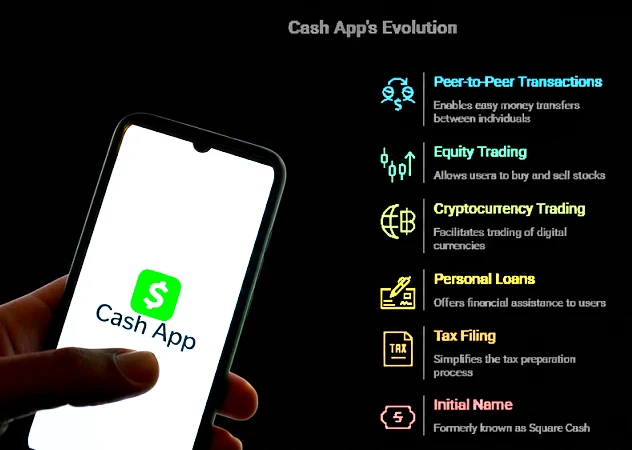
Cash App is a money transfer application for peer-to-peer transactions, which launched in 2013. The platform is designed to enable users to trade equities, transfer money, followed by selling & buying cryptocurrency.
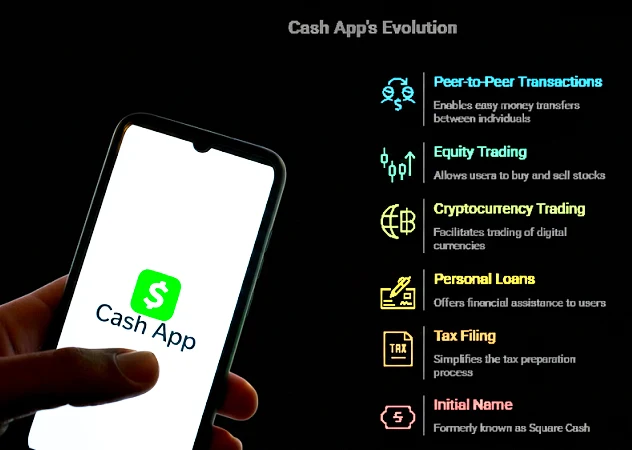
Meanwhile, Cash App initially supported the peer-to-peer money transfer process, while formerly, at the time of inception was called Square Cash. Soon after the inception, the explanation and consolidation made the business deal with stock investing, personal loans, tax filing, and much more.
The truth behind the lawsuit with Cash App settlement
The ordeal behind theCash App settlement began with the “Invite Friends” option led by Cash App as a marketing promotional tactic to take users in terms of new customer referrals. The main motto of Cash App was to earn a small return from referrals, while invitations were sent to many users. Meanwhile, the chaos became an eye-opener for many people while the actual truth came forward. Despite no initiation of sign-up by users through Cash App, they were receiving messages from the app without their prior consent ignites the hostility.
According to the Consumer Protection Act as well as the Telephone Consumer Protection Act (TCPA), before sending anything to customers, any business needs to accept prior and clear customer consent to send them automated text messages. Hence, it does not matter how trusted or legitimate the platform is; messaging without approval is classified as spam.
Parent company Block, Inc denied the claim but came up with an agreeable settlement to defend the cost and uncertainty behind the ordeal. Above all, the lawsuit against the case makes its backdrop from a trivial text messaging just for gaining a referral end up with a sparkling lawsuit by the court.
Who had qualified for a cash app settlement?
Not everyone who once in a while used the platform is eligible to get money back through Cash App. Certain benchmark criteria act as a deciding factor behind who qualifies for the settlement claim or who doesn’t.
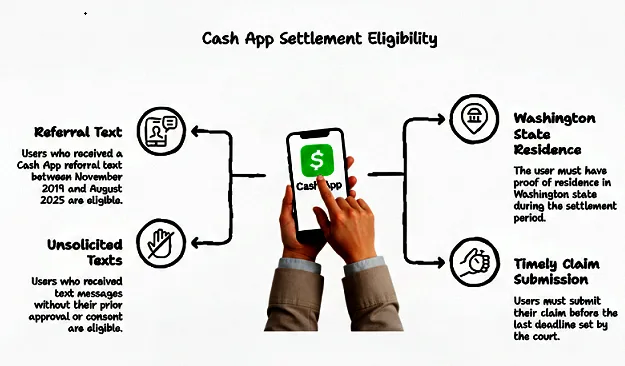
Let’s have a look at the eligibility criteria to determine who was earlier opted to receive the Cash App settlement benefits.
👉 According to the Economic Times, users who received a Cash App text message between November 14, 2019, and August 7, 2025, as a referral text were eligible to go for the settlement. The deadlines had already closed, so no longer accepted any new application claims.
👉 The user had a proof of residence in Washington state during the period. Hence, nowhere else except Washington state claimants were eligible to apply.
👉 Users who had received text messages without their prior approval or consent
👉 Users had to submit the claim before the last deadline, which was October 27, 2025, set by the court.
Key takeaways about important dates
| Settlement Event | Date |
| Start date who were eligible to claim for unsolicited text | November 14, 2019 |
| End date who were eligible to claim for unsolicited text | August 7, 2025 |
| Claim submission deadline | October 27, 2025 |
| Final court approval | December 2, 2025 |
| Expected payments | Early 2026 |
Payment distribution to approved claimant- When and How
After the final round of approval by the court, the case goes straight to the final payment distribution stage. Here, nothing is left for the claimant to deal with the cash app settlement. Payments disbursed within early 2026, with the intended payment mode during the process of filling.
It can be a digital transfer through electronic payment, a paper check, or a direct deposit that connects to Cash App. Afterwards, the claims got verified by the administrator through the process of duplication elimination and identifying invalid entries. To check the payment status, members need to visit the official portal for further updates.
Essential Tips to Protect Your Cash App Account
These myriad approaches help you to protect your Cash App account. Let’s have a look at the essential tips below.
- Set a strong alphanumeric password: If you want to keep your Cash App free from any breach of trust or security compromise, always set a strong alphanumeric password. Always remember that your password must be unique and different for every website.
- Enable two-factor authentication: Turning on the two-factor authentication (TFA) on your account adds an extra security measure that someone can help you evade any security threat, making your Cash App account less vulnerable.
- Carefully review every detail, transaction, or activity log check: if you want to keep your Cash App account free from any illegal theft, all you need is just carefully reviewing every detail, transaction, or activity log check to never let anything unintended occur.
- Stay vigilant, stay informed: If you want to get the maximum from Cash App, go through every recent update revolving around the platform to never let anything unanticipated happen.
Protect Yourself from Spam Texts like Cash App- Some Troubleshooting
Are you really irritated by unwanted messaging by Cash App or anything like that? Now it’s time to keep yourself protected from spam Texts. All you need to do is just follow the basic troubleshooting.
- If you are getting promotional text, no need to worry. Hence, you need to keep yourself opted out by simply replying “UNSUBSCRIBE” or “STOP”.
- You can go for the third-party application or any built-in features of your phone to filter out spam messages.
- Filing a complaint or litigation on the website reportfraud.ftc.gov. Help you to tackle the Spam Texts issues.
- Keep checking sms permission and the notification bar on your phone regularly.
Wrapping up
The Cash App settlement highlighted the relevance of user intent in today’s digital era. Sending a message without any user intent can cause legal repercussions. The ordeal in the Cash App settlement case pinpoints the significance of the consumer protection role in the digital ecosystem. The incident of the cash app settment remind business about the necessity to acknowledge consumer consent before sending anything.
Frequently asked questions (FAQs)
Ans: Block was entitled to settle the matter for $12.5 million.
Ans: Kimberly Bottoms, the plaintiff, allegedly stated that the referral mechanism by Cash App sends unsolicited messages to users without their prior consent.
Ans: No, the first and foremost eligibility requirement behind the claim was to have proof of Washington resident who had received unsolicited messages between November 14, 2019, and August 7, 2025, via Cash App.